
Panchang, a cornerstone of Vedic astrology, is a Hindu calendar that outlines the positions of celestial bodies to identify auspicious times for events. So, what is Panchang? It is made up of five components—Vaar (day), Tithi (lunar day), Karana (half-day), Nakshatra (star), and Yoga (angular relationship). This guide explores how the Panchang influences daily activities and important events.
Key Takeaways
- Panchang is a vital tool in Vedic astrology, featuring five components that provide insights into auspicious timings and celestial influences on daily activities.
- The five elements of Panchang—Vaar, Tithi, Karana, Nakshatra, and Yoga—collectively guide the selection of favorable days and times for significant life events, such as weddings and ceremonies.
- Using the Panchang effectively involves not only identifying auspicious times but also avoiding inauspicious periods to ensure successful outcomes in various cultural and spiritual practices.
Understanding Panchang: The Basics
The Panchang plays a vital role in Vedic astrology, serving as a guide to predict changes and provide detailed daily information. Rooted in the rich tradition of Indian astrology, Panchang is an essential tool that uses mathematical calculations to enhance one’s life. The term ‘Panchang’ translates to ‘five limbs’, each representing a critical aspect of astrological data, making it an indispensable resource for understanding Hindu astrology and the Hindu calendar. An astrologer often relies on the Panchang for accurate predictions.
Each component of the Panchang contributes to a holistic comprehension of time and its influences on human activities. Unlike the Gregorian calendar, the Panchang offers a more nuanced view of time, integrating both the lunar and solar movements to provide a comprehensive perspective. Each day of the week is associated with a different planet and deity, which influences the activities deemed suitable for that day, further intertwining the celestial and the terrestrial.
This traditional Hindu calendar is not just a relic of the past but a living document that continues to guide millions in their daily lives. Exploring its components reveals the secrets of time and celestial rhythms.
Components of Panchang
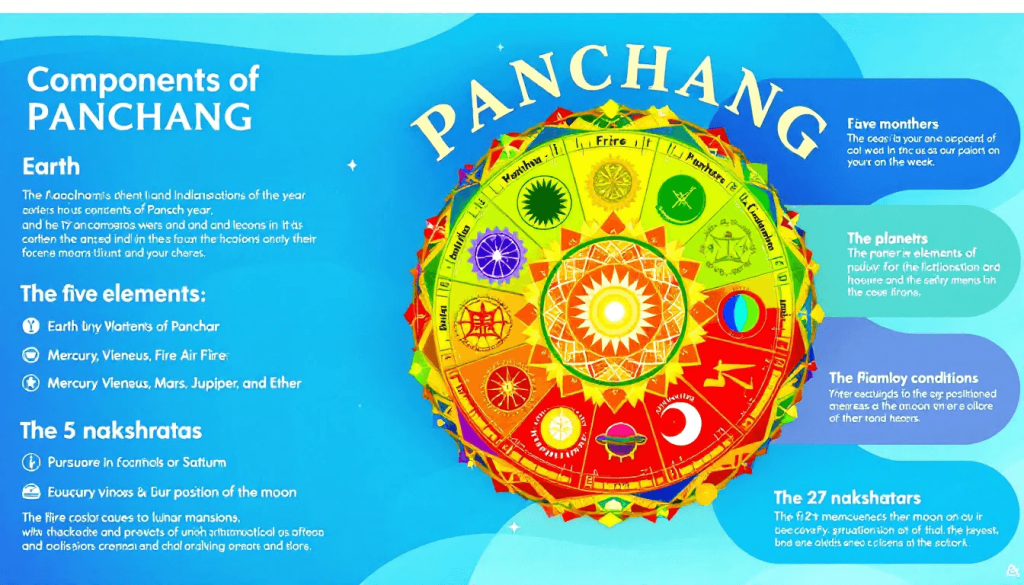
The Panchang’s intricate design is composed of five main components, often referred to as the ‘five limbs’ or ‘five elements’ in this world. Each of these elements offers unique insights into the cosmic phases that govern our lives.
The first component, Vaar, represents the day of the week, each ruled by a specific ruling planet or planets. For instance, Monday is governed by the Moon, and Tuesday by Mars. This association influences the activities deemed suitable for each day, showcasing the practical utility of the daily Panchang.
Next, Tithi signifies the lunar day, calculated based on the angular distance between the Sun and Moon. There are 30 distinct Tithis in a lunar cycle, each with its own significance. One tithi is critical in determining the timing of Hindu festivals and rituals.
Karana, the third component, refers to the half-day subdivisions of Tithi. Each Tithi contains two Karanas, amounting to eleven types overall. These small divisions help in pinpointing more precise moments within a day, adding another layer of granularity to the Panchang.
Nakshatra, the fourth component, divides the zodiac into 27 parts, each ruled by a particular star. Each Nakshatra is further divided into four padas, which span short segments within a zodiac sign, influencing various aspects of life and personality traits.
Lastly, Yoga is the sum of the longitudes of the Sun and Moon, creating a unique combination that influences the auspiciousness of the day. Understanding these components allows astrologers to offer precise guidance on the best times for various activities.
How Panchang Influences Daily Life
In the tapestry of daily life, the Panchang serves as a guide for planning ceremonies, rituals, and identifying auspicious times. Whether it’s a wedding, a business launch, or moving into a new home, aligning these significant events with favorable celestial conditions can enhance their success.
The Panchang provides specific timings that are considered favorable for significant life events. Choosing the right moment for a religious ceremony aligns the event with cosmic energies, enhancing its spiritual efficacy. Pinpointing significant dates helps individuals make decisions aligned with positive celestial influences.
From religious events to business launches, the Panchang helps determine auspicious timings for a wide range of activities. Selecting auspicious dates involves analyzing the alignment of celestial bodies with specific activities. This ancient wisdom aligns cultural and spiritual practices with favorable cosmic timings.
Using Panchang for Auspicious Times
The Panchang is an indispensable tool for identifying auspicious times for life’s important events. Understanding astrological components like Nakshatras and Yogas helps individuals make informed decisions about new ventures or significant milestones.
Analyzing celestial factors ensures these moments align with positive energy, enhancing success.
Determining Auspicious Dates
The Panchang helps find beneficial timings for various activities using the positions of celestial bodies. Examining the daily Panchang on a daily basis reveals the most favorable days and times for important activities.
Mathematical calculations consider the lunar day, planetary positions, and other elements to ensure propitious moments, including the luni-solar day. This precise calculation is crucial for activities that require specific auspicious dates, like weddings or business launches.
For instance, the Panchang can guide you in selecting an auspicious marriage date, ensuring the union’s success and happiness.
Avoiding Inauspicious Times
Identifying inauspicious periods is vital to avoid unfavorable outcomes during important events. The Panchang includes specific periods, such as Rahu Kalam, that are considered inauspicious times for starting new ventures.
Recognizing these unfavorable periods, or bad times, allows individuals to plan activities and avoid misfortune. Starting a new business during Rahu Kalam is believed to lead to obstacles and challenges.
Identifying periods to avoid is based on astrological events that may lead to negative outcomes. This ancient wisdom ensures your significant activities are free from celestial hindrances.
Panchang and Hindu Festivals
The Hindu calendar, known as hindu panchang, plays a crucial role in scheduling religious ceremonies and festivals, integrating both lunar and solar cycles. Hindu festival dates are determined by the positions of celestial bodies, primarily the Sun and Moon.
Hindu festivals are celebrated according to different months in the lunar calendar outlined in the Panchang. Each festival includes specific rituals and auspicious timings, often calculated using the Panchang.
Regional variations in the Hindu calendar cause differences in festival dates and observances across communities. For instance, Sankranti marks the transition of the Sun into a new zodiac sign and is seen as an auspicious time for charitable acts.
Summary
The Panchang, with its rich tradition and precise calculations, remains a cornerstone of Hindu culture. Its five components offer a comprehensive understanding of time and its celestial influences, guiding individuals in making informed decisions.
From influencing daily activities to planning significant life events, the Panchang ensures alignment with cosmic energies, enhancing the success and spiritual efficacy of these moments. It also plays a vital role in scheduling Hindu festivals, integrating lunar and solar cycles to mark auspicious dates.
Incorporating Panchang into your daily life can lead to a more harmonious existence, aligned with the rhythms of the universe. Embrace this ancient wisdom and let it guide you to a prosperous and fulfilling life.
Frequently Asked Questions
What is Panchang?
Panchang is a traditional Hindu calendar that offers daily insights based on celestial movements, aiding in event planning and predictions. It serves as a vital tool for determining auspicious timings for various activities.
How does Panchang influence daily life?
Panchang significantly influences daily life by guiding individuals in planning ceremonies, rituals, and identifying auspicious times, thus aligning actions with favorable celestial influences. This alignment promotes a sense of harmony and success in various activities.
What are the main components of Panchang?
The main components of Panchang are Vaar (day of the week), Tithi (lunar day), Karana (subdivisions of Tithi), Nakshatra (lunar mansion), and Yoga (the combined position of the Sun and Moon). These elements are essential for determining auspicious timings in Hindu rituals and astrology.
How are auspicious dates determined using Panchang?
Auspicious dates are determined by analyzing celestial positions and calculating favorable timings for specific activities. This method uses the Panchang, which provides insights based on lunar cycles, planetary positions, and other astrological factors.
Why is it important to avoid inauspicious times in Panchang?
Avoiding inauspicious times in Panchang, such as Rahu Kalam, is essential to prevent unfavorable outcomes and enhance the success of significant events. This practice helps align activities with favorable planetary positions.