Mercury Retrograde Ends July 2026: Outer-Planet Alignments
By Ravi Khorana

The Exhale That Isn't
A particular kind of relief arrives — incomplete, slightly dizzying — when a held breath finally escapes the lungs. Not quite the freedom you imagined. Mercury retrograde ends on July 23, 2026, and the collective sigh will be loud enough to register on social media seismographs. Memes will land. "We survived" posts will circulate. Then, slowly, people will notice that something still feels off. Exactly.
That lingering pressure is not Mercury's doing. The story July 2026 tells belongs to the outer planets — Uranus, Neptune, and Pluto — and to a rare configuration called the Barbault Basket that peaks just days before Mercury turns direct. Mercury's retrograde isn't the chapter. It's the annotated footnote.
Mistaking the footnote for the chapter is the kind of error that leaves you disoriented when the relief you expected does not quite arrive.
Mercury in Cancer: More Than a Communication Glitch
Mercury's retrograde through Cancer, from June 29 to July 23, has never been about Wi-Fi connections. Both Western and Vedic traditions agree on this, though by different routes.
From a Jungian archetypal perspective, Mercury retrograde in Cancer activates the domain of memory, emotional narrative, and what psychologist Christopher Bollas called "the unthought known" — those inherited relational templates running quietly below the surface of awareness. This retrograde is less about scrambled logistics and more about an involuntary deep dive into your own past.
From a Vedic lens, the picture is pointed. Mercury — Budha in Sanskrit — occupies enemy territory in Cancer as the Moon's watery realm contrasts Mercury's dry, discriminative intelligence. The direct station occurs at approximately 16 degrees of Cancer, within Ashlesha Nakshatra, ruled by the Nagas (serpentine energies associated with concealment and insight). Ashlesha's power — vishasleshana shakti — penetrates to root truths, often revealing uncomfortable realities instead of offering comfortable closure.
The Shadow Period Is Real
Every tradition here agrees: Mercury stationing direct on July 23 does not mean Mercury is "back to normal." The post-retrograde shadow persists through August 6 or 7, as Mercury retraces the degrees it covered while retrograde. Vedic astrology frames this through the concept of chesta bala — strength derived from a planet's motion. A newly direct planet has minimal chesta bala; it moves slowly, tentatively. Mercury's roles (commerce, contracts, travel, speech) operate below full strength for at least two more weeks.
Key takeaway: Hold major contracts and binding commitments until after August 6 at minimum. This period belongs to review, amendment, and consolidation, not initiation.
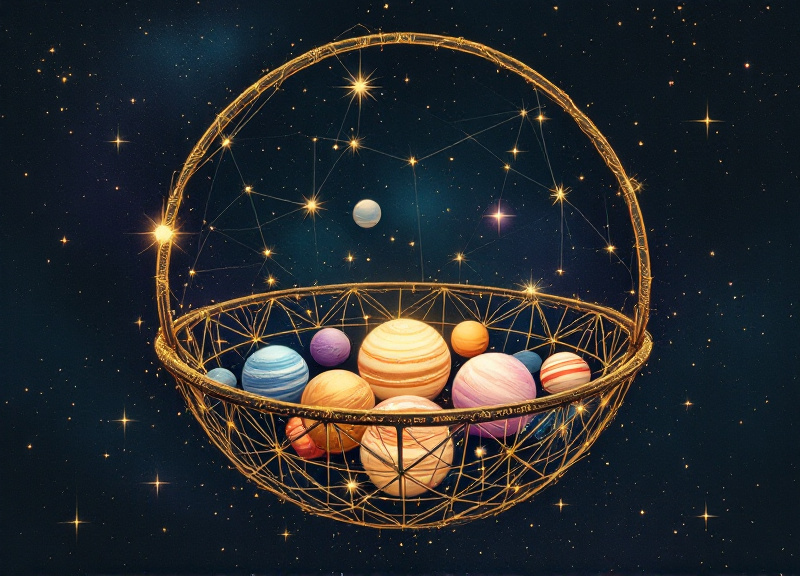
The Barbault Basket: What Is It and Why Does It Matter
Here's what most commentary will miss: the Barbault Basket peaks around July 19 through 21 — before Mercury even stations direct. The two events overlap but operate on different timescales.
André Barbault, a French astrologer, mapped planetary cycles against collective historical events, assigning numerical indices to planetary distances and correlating them with major societal upheavals. His work documented correlations between concentrated outer-planet configurations and historical inflection points, including the World Wars, decolonization movements, and the Cold War's turning points. His methodology was unusually rigorous; he engaged with falsifiability more seriously than most in his tradition. Even so, mainstream social science hasn't validated his specific claims.
The Barbault Basket denotes a rare clustering of outer planets that historically correlates with collective reset points more than personal inconvenience. The Barbault Basket doesn't care about your email delays. It describes structural pressure on political, economic, and social systems that won't dissolve when Mercury turns forward.
The Uranus-Pluto trine within this configuration adds its weight. Where the Uranus-Pluto square of 2012 to 2015 brought visible disruptions and confrontations, the trine works more subtly — structural transformations proceeding with an air of inevitability, rather than crisis. Think tectonic shifts, not earthquakes.
A Note of Honest Tension
The empirical case for the Barbault Basket as a predictive tool remains interpretive rather than proven. Repeated statistical analyses have failed to find significant measurable effects attributable to planetary positions in the way astrologers describe them. What is measurably real, however, is the confirmation bias loop and — more generously — the genuine sociological function of shared interpretive frameworks during periods of collective uncertainty. Astrology's cultural power lies in the vocabulary it provides, regardless of celestial causation.
That said, Barbault's correlations are among the more methodologically serious efforts in the tradition. Ignoring them entirely requires dismissing pattern recognition that warrants investigation.
The Nodal Shift Into Leo-Aquarius: Collective Crossroads
Compounding everything is the shift of the lunar nodes onto the Leo-Aquarius axis, a pattern last active in 2007 — a year preceding the 2008 financial crisis and the dawn of the smartphone era.
The Western psychological reading is compelling: the North Node in Leo draws the collective toward courageous self-expression and authentic creative authority. The South Node in Aquarius asks us to release unconscious refuges — detachment as higher principle, collective identity substituted for individual soul work.
Vedic astrology sharpens the edge. Rahu transiting Simha (Leo) intensifies ambition, nationalism, and the hunger for recognition. Ketu in Kumbha (Aquarius) dissolves idealism, technological certainties, and group identities. The axis, last active before financial and political disruptions, coincides with a cultural timing that is conspicuous: a nodal axis activating the Leo-Aquarius polarity arrives with intensifying public discourse around AI governance, individual creative rights, and the tension between platform economies and independent identity. Coincidence or cosmic curriculum — the resonance is hard to ignore.
Where the Experts Agree — and Where They Don't
Universal Agreement
Across all perspectives, three points converge:
- Mercury stationing direct is not the "all clear." The shadow period through August 6-7 is a legitimate transitional zone.
- The outer-planet configuration dwarfs Mercury's personal-planet drama. July 2026's significance operates on generational timescales.
- The 2007 nodal parallel is suggestive — not predictive, but worth attention.
The Productive Disagreement
Interesting tension emerges between traditions on what to do with all this:
- Vedic astrology offers concrete remedies: mantra recitation (Om Bram Breem Braum Sah Budhaya Namah on Wednesdays), gemstone recommendations (emerald or green tourmaline), and charitable acts on Saturdays for Saturn's collective demands. Centuries-old prescriptive tools.
- Jungian psychological astrology avoids prescription, favoring awareness practices: journaling retrograde themes, practicing "collective witnessing" (recognizing transpersonal pressure as shared), and sitting with tension rather than rushing to resolve it.
- The cultural-sociological view suggests the framework itself is the medicine — shared astrological vocabulary reduces social isolation and normalizes difficulty.
None of these approaches is wrong. They serve different needs, and you can draw from all three.
Practical Guidance: What to Do Between July 23 and August 7
Resist the impulse to rush. The post-retrograde shadow is a decompression zone. Treat major communications and decisions with a light touch, not from superstition, but from genuine awareness that understanding consolidates gradually.
Choose one conversation that went sideways during the retrograde. Write what you meant to say, even if only in a journal. Cancer values emotional truth.
Hold awareness of collective pressure as genuinely collective. When anxiety, urgency, or the sensation that something must change right now hits during late July, ask yourself: is this mine, or the weather? That question alone offers enough distance to observe rather than just react. Understanding your birth chart can help identify where this transit hits you directly.
For Vedic practitioners: recite the Budha Beej Mantra on Wednesdays. Saturday charitable acts — donations of black sesame seeds, service to the elderly — honor Saturn's demands. Consider crystal remedies in line with Mercury's roles.
Set a Leo-Aquarius intention after August 6: Where in your life are you being called to visibility for something larger than personal recognition? Write it plainly. Keep it visible.
July 2026 Quick-Reference Timeline
| Date | Event | What It Means for You |
|---|---|---|
| July 19-21 | Barbault Basket peaks | Collective pressure intensifies; not personal, but you will feel it |
| July 23 | Mercury stations direct (16° Cancer, Ashlesha Nakshatra) | The compass needle stops spinning — but read the terrain before moving |
| July 26 - Aug 1 | Shadow period + fresh nodal axis + Barbault resonance | Best for council and conversation, not contract signing |
| Aug 6-7 | Mercury clears retrograde shadow | Green light for commitments, launches, formal decisions |
| Aug 9 | Mercury enters Leo | Communication shifts from introspective to declarative |
| Aug 15 | Mercury conjunct Jupiter in Leo | Expansion of voice — bold speech, big ideas, potential overstatement |
Frequently Asked Questions
Is it safe to sign contracts after Mercury goes direct on July 23?
Technically, Mercury is moving forward, but both Vedic and Western traditions recommend waiting until the shadow period clears around August 6-7. Mercury's motion remains sluggish (low chesta bala in Jyotish terms), and the degrees it retraces are the same ones that caused confusion during the retrograde. If you must sign, review with extra care and build in flexibility for amendments.
What is the Barbault Basket, and should I be worried?
The Barbault Basket, a rare concentration of outer planets, is named after French astrologer André Barbault. It correlates with major collective shifts and operates at a societal level — economic or political restructuring, not personal. No panic needed, but recognize that the ambient pressure of late July 2026 is due to something larger than Mercury. Stay informed and grounded rather than anxious. Check your daily horoscope for personalized guidance.
What does the nodal shift into Leo-Aquarius mean for my relationships?
The Leo-Aquarius axis activates themes of individual expression versus collective belonging. In relationships, tension may arise between personal creative needs and shared ideals. If you question whether a partnership supports your authentic self-expression or demands you disappear into a group identity, you're on theme. The compatibility tools can help explore these dynamics in your specific charts.
I am a Gemini/Virgo rising. Does this Mercury retrograde hit me harder?
Yes — Mercury rules both Gemini and Virgo ascendants, so its retrograde and recovery affect you more directly. Vedic remedies like wearing emerald or green tourmaline, set in gold on the right hand's small finger, can support Mercury's roles in your chart. A detailed look at your natal chart will reveal which house Cancer falls in for you and which life area has been under revision.
How is July 2026 similar to 2007?
The key parallel is the lunar nodes shifting onto the Leo-Aquarius axis, last occurring in late 2007. That period preceded the 2008 financial crisis and the early smartphone revolution — events that restructured how individuals related to collective systems. The parallel is suggestive, not predictive. History doesn't repeat, but astrological cycles rhyme. The broader theme for the next eighteen months is the tension between individual creative sovereignty and collective technological infrastructure.
Ready to explore your cosmic blueprint?
Discover what the stars reveal about your unique path.
Check Your Transit Chart

