August 2026 Lunar Eclipse: Transform Your Weekly Horoscope
By Ravi Khorana

An Eclipse Is a Destination, Not a Detonation
Here's the thing almost every eclipse article gets wrong: they treat the eclipse as an isolated event, a cosmic detonator that just drops out of the sky on a single evening. But it doesn't work that way. Every expert we consulted — Vedic, Western psychological, cultural, and cross-traditional — landed on this same bedrock point.
The partial lunar eclipse on August 28, 2026 (peaking at roughly 12:18 a.m. EDT) is the culmination of a lunar arc that begins with the New Moon on August 12. The whole month is building toward this moment (which, if you think about it, makes sense). Your weekly horoscope routine for August shouldn't treat that eclipse night as a standalone spectacle. It should treat the whole month as a single story unfolding in four chapters.
And this also means the eclipse's effects don't just land and vanish in a single night. The 17th-century astrologer William Lilly taught that eclipse effects unfold over months proportional to the eclipse's duration. Classical Vedic texts describe a six-week influence window. Modern behavioral psychology, meanwhile, has documented what researchers call the fresh start effect — the measurable tendency for people to audit habits and commit to changes around publicly marked transition points. An eclipse, framed honestly, is one of the most potent temporal landmarks available.
The bottom line? Whether you believe the eclipse reshapes your karma or simply gives your brain a meaningful anchor for change, the real-world outcome is the same — August 2026 is a month to restructure your weekly rhythms with intention.
The Zodiac Debate: Pisces-Virgo or Aquarius-Leo?
This is where things get genuinely interesting, and where honest astrology requires holding two truths at once.
Western tropical astrology places the eclipsed Moon at roughly 4 degrees 54 minutes of Pisces, opposite a Virgo Sun. This activates the Virgo-Pisces polarity — the axis of feeling versus function, surrender versus service, the dream versus the schedule. From a Jungian perspective, this is the tension between the ordering ego (Virgo) and the boundless unconscious (Pisces). So, has your weekly routine become armor against your emotional life, rather than support for it?
Vedic sidereal astrology (Jyotish), calculating from the fixed star backdrop rather than the tropical seasons, places the same eclipse along the Aquarius-Leo axis. This shifts the emphasis from daily habit toward collective identity versus individual creative will, disciplined detachment versus the ego's hunger for recognition. It's a different question entirely — not "are your routines serving your feelings?" but "are you showing up as yourself, or performing a role your community expects?"
Neither reading is wrong. Together, they give you a fuller picture.
The Virgo-Pisces axis says: audit your daily life for places where obligation has quietly displaced meaning. The Aquarius-Leo axis says: examine where personal expression has been subordinated to group expectation. Your habits are both private and communal. This eclipse presses on both.
What this means for your horoscope practice? If you work with Western astrology, look at which houses Pisces and Virgo occupy in your birth chart. If you follow Vedic tradition, check where Aquarius and Leo fall. If you honor both — and at Deluxe Astrology, we think that's the richest approach — you get a two-axis map of the eclipse's territory in your life.
What Saturn Rising Actually Means
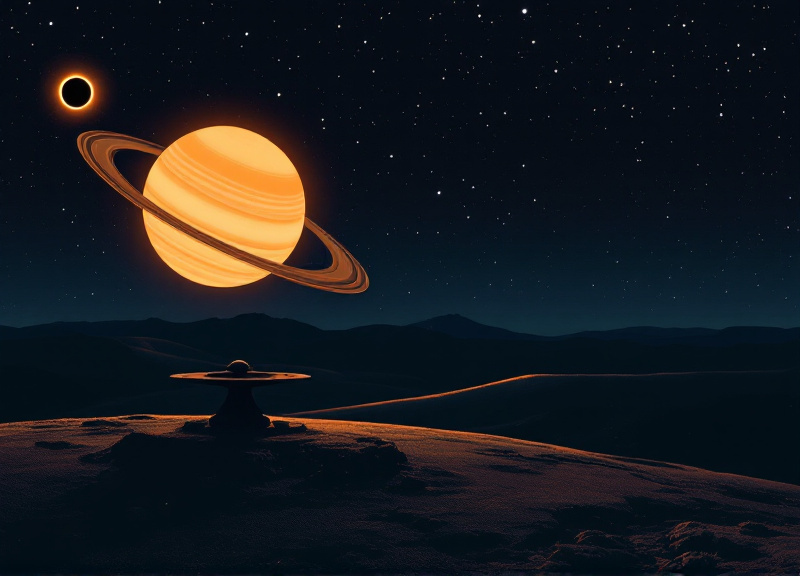
Most eclipse coverage focuses on the Sun-Moon opposition. Almost none addresses the fact that Saturn rises in the east-northeast during this eclipse's maximum. One of our experts flagged this as the most overlooked detail in the entire August 2026 sky.
Saturn standing watch as the Moon dims is not just atmospheric. In every major astrological tradition, Saturn governs time, structure, earned wisdom, and the slow labor of building something durable. Its visible presence during this eclipse carries a pointed message — the emotional clearing this eclipse invites isn't cleanup (and honestly, this one catches people off guard) — it's construction in disguise.
You're not simply releasing what hurts. You're being shown which structures in your weekly life were never designed to hold what you actually carry. That overloaded Wednesday schedule, that Sunday night anxiety spiral, that weekly horoscope check that's become more compulsive reassurance-seeking than genuine self-reflection — Saturn says these structures need rebuilding, not just abandoning.
From the Vedic perspective, Saturn as eclipse witness reinforces themes of accountability, karmic reckoning, and disciplined restructuring. This meshes nicely with the Western psychological reading that the eclipse makes unconscious patterns uncomfortably visible. Saturn's presence adds: and now you have to do something about it.
Key takeaway: Saturn at the eclipse edge asks you to think in seasons, not weeks. The routine you build after August 28 should be designed to hold weight across months, not just survive the next seven days.
The Four-Phase August Lunar Arc
Oh, and there's more — all four of our expert perspectives converged on a surprisingly consistent four-phase structure for August 2026. Here's how to use it:
Week of August 12 (New Moon) — Seed. Set one clear intention for your daily life. The Vedic tradition calls this your sankalpa (sacred resolve). Keep it simple. Write one sentence about what you're genuinely trying to build in your routines — not what you think you should want, but what your body and rhythms actually suggest matters to you.
Week of August 19-20 (First Quarter) — Tension. Read that intention against your current weekly schedule. Where does the schedule serve it? Where does it quietly contradict it? This is the natural decision point — commit to the emerging pattern or notice your resistance. Friction here is data, not failure.
Week of August 25-27 (Pre-Eclipse) — Simplify. Reduce your scheduling load. Cancel one obligation that was never truly yours to carry. Create at least one hour of unscheduled space each day. Classical Jyotish advises against signing contracts, beginning new medical treatments, or launching major negotiations in the 48-hour window around the eclipse. The psychological rationale supports this: when the Moon is obscured, your gut-level emotional intelligence is temporarily less reliable.
Night of August 27-28 (Eclipse) — Observe. If your sky is clear and you're in the Americas or western Europe, the Moon enters partial shadow between roughly 10:33 p.m. and 3:01 a.m. Eastern. Sit with the dimming. Journal one question: What does my body know that my schedule has been ignoring? Write the answer without editing. That answer becomes your revised compass for autumn.
The Psychology of Eclipse Routines
Here's an honest tension worth sitting with: does this eclipse actually do something to you, or does it simply hand you a powerful excuse to do something for yourself?
Our cultural expert pointed to peer-reviewed research — notably the 2014 Dai, Milkman, and Riis study in Management Science — showing that designated transition points measurably increase habit change and intention-setting, regardless of any literal celestial causation. An eclipse, culturally framed as a reset, functions as exactly this kind of temporal landmark.
Our Vedic and Western psychological experts, meanwhile, would argue that the eclipse's effects are not reducible to expectation alone. The Vedic perspective holds that Rahu and Ketu (the lunar nodes) literally shadow the Moon's capacity for mental clarity — the manas (mind) is pressurized, not merely symbolically but functionally. The Jungian frame sees the eclipse as a synchronistic event that interrupts the ego's autopilot, making unconscious patterns suddenly, uncomfortably visible.
We don't think you need to resolve this debate to benefit from it. Whether the eclipse acts on your psyche through celestial mechanics or through the power of meaningful temporal framing, the real-world result is the same — August 28, 2026 is an unusually ripe moment to audit your routines, release what no longer serves you, and rebuild with greater honesty.
Vedic Remedies and Nakshatra Wisdom
For those working within the Vedic framework, this eclipse carries distinct Nakshatra (lunar mansion) significance. The sidereal Moon falls across Dhanishtha and Shatabhisha — two Nakshatras with profound relevance to routine and healing.
Dhanishtha, governed by the Ashta Vasus, carries the shakti (power) of rhythm and resonance. When an eclipse strikes here, routines maintained by sheer momentum rather than genuine purpose will buckle. Shatabhisha, the Nakshatra of a hundred healers, holds the power of bheshaja — healing through perception. An eclipse here draws attention toward what's been concealed or unprocessed in your emotional body.
The prescribed Vedic remedy during the eclipse window is repetition of the Chandra Beej Mantra — Om Shram Shreem Shraum Sah Chandramasay Namah — recited 108 times near maximum eclipse. Charitable giving of white foods (rice, milk, white sesame) is additionally recommended by Parashara for eclipse periods.
If you're running a Rahu, Ketu, or Moon Mahadasha (major planetary period), this eclipse will resonate with particular force. Pay extra attention to sleep, emotional boundaries, and avoiding impulsive communications during eclipse week. You can check your planetary periods using a birth chart calculator.
Quick Reference: August 2026 Lunar Eclipse at a Glance
| Detail | Information |
|---|---|
| Date | August 27-28, 2026 |
| Eclipse type | Partial lunar eclipse |
| Peak time | ~12:18 a.m. EDT, August 28 |
| Western (tropical) position | ~4°54' Pisces (Moon) opposite Virgo (Sun) |
| Vedic (sidereal) position | Aquarius (Moon) opposite Leo (Sun) |
| Nakshatras activated | Dhanishtha / Shatabhisha |
| Saturn | Rising in the east-northeast at eclipse maximum |
| Visibility | Americas, western Europe, parts of Africa |
| Influence window (Vedic) | ~6 weeks surrounding August 28 |
| Key themes | Routine audit, emotional honesty, structural rebuilding, rest vs. productivity |
FAQ: Your August 2026 Eclipse Questions
Should I avoid reading my weekly horoscope during the eclipse?
Not at all — but consider how you're reading it. This eclipse is a perfect moment to ask whether your weekly horoscope habit has become genuine self-reflection or just a hunt for reassurance. If you find yourself anxiously checking multiple sources for confirmation, the eclipse is already showing you something worth examining.
The Western and Vedic zodiacs place this eclipse in different signs. Which one should I follow?
Both, ideally. The tropical Pisces-Virgo reading highlights your daily routines and the tension between structure and surrender. The sidereal Aquarius-Leo reading highlights your relationship between individual expression and collective belonging. They're complementary, not contradictory. Check both axes in your birth chart to see which houses light up.
Is the eclipse actually a bad time to start new things, or is that superstition?
There's real reasoning behind the caution. The Vedic tradition holds that the Moon's mental clarity is literally compromised during eclipses. Western psychological astrology argues your gut-level emotional intelligence is temporarily less reliable. Behavioral psychology adds that high-emotion transition points are poor moments for irreversible decisions. None of this means you should freeze for a week — just avoid signing major contracts or locking in permanent commitments in the 48 hours around the eclipse peak.
What if I don't know my Vedic birth chart or Mahadasha period?
You can generate a Vedic chart using our astrology calculators. Even without exact Mahadasha information, you can still work with the four-phase August lunar arc outlined above — that structure is calendrically grounded and doesn't require chart-specific data to be useful.
How is this eclipse different from a regular Full Moon?
A Full Moon illuminates. An eclipse interrupts. The difference is that during a regular Full Moon, your emotional patterns are heightened but running normally. During an eclipse, those patterns are made visible precisely because they've been disrupted. Think of it as the difference between seeing your reflection in a mirror (Full Moon) and having the mirror momentarily go dark, forcing you to notice how much you depended on it (eclipse).
Ready to explore your cosmic blueprint?
Discover what the stars reveal about your unique path.
Read Your Daily Horoscope

