Moon Signs Explained: Your Emotional Blueprint Revealed

Why Your Sun Sign Only Tells Half the Story
You can know someone's Sun sign for a decade and still be blindsided by how they fall apart — or hold together — under pressure. Exactly. The Sun narrates the hero's journey: the ambition, the persona, the face turned toward the world. But the Moon holds the root system. And roots do not care about the story you're telling yourself.
Here's the thing: when you say "I'm a Leo" or "I'm a Capricorn," you're referencing your Sun sign — where the Sun was positioned at your birth. That tells you something real about your conscious identity and creative drive. Not quite. It says almost nothing about what you reach for at 2 a.m. when you can't sleep, or why certain people feel like home while others feel like sandpaper.
That's your Moon sign's territory. Increasingly, people are catching on. Google Trends data shows that searches for "moon sign calculator" have outpaced "what is my zodiac sign" in recent years. Apps like Co-Star and Pattern, which center the full natal chart rather than Sun-sign columns, have collectively accumulated over 20 million downloads. We're watching a cultural correction in real time — a return to something ancient astrologers knew all along.
What Exactly Is a Moon Sign?
Your Moon sign is the zodiac sign the Moon occupied at your exact moment of birth. Because the Moon moves fast — traversing the entire zodiac in roughly 28 days, changing signs every two and a half days — it's one of the most individualized points in your chart. Two people born on the same day can carry fundamentally different emotional architectures if the Moon shifted signs between their births.
That speed is actually the Moon's fundamental message: emotional reality is not fixed. It is tidal. Your Moon sign describes your instinctive emotional responses, your attachment patterns, your private needs, and — as both Vedic and Western traditions agree — the template of your earliest experiences of being cared for.
To find yours, you'll need your birth date, birth time, and birth location. A birth chart calculator will show you exactly where the Moon was when you arrived.
Where Every Tradition Agrees — And Where They Don't
Here's something remarkable: every major astrological lineage treats the Moon as the primary indicator of the inner life, and each arrives at that conclusion through a different door.
Western psychological astrology, drawing on Jungian depth psychology, sees the Moon as the inner child — the archetype of the Great Mother internalized. In the work of Liz Greene and Howard Sasportas, the natal Moon maps how you internalized your earliest caregiving environment and the implicit rules you learned about whether the world was safe enough to feel fully in. The Sun represents who you're becoming; the Moon represents the emotional substrate from which you began.
Vedic astrology (Jyotish) goes even further. The Moon — called Chandra — is designated the karaka (significator) of Manas, which translates not just as "emotion" but as mind itself: the complete apparatus of perception, reaction, memory, and relational instinct. The foundational text Brihat Parashara Hora Shastra places Chandra at the center of its primary predictive system. Your entire Vimshottari dasha — the timing sequence that maps the unfolding of your life — is calculated from the Moon's position, not the Sun's.
This isn't a small distinction. From the Vedic perspective, the Sun (representing Atma, the soul's essential nature) shows what you are in essence. The Moon shows how that essence incarnates into lived, daily, felt experience. You experience your marriage, your grief, your hunger, and your fear through the Moon's constitution.
Where the tension lives: these two traditions use different zodiacs. The sidereal zodiac (Vedic) and the tropical zodiac (Western) differ by approximately 24 degrees. This means your Western Moon sign and your Vedic Moon sign may not match. More on that below — it matters more than most platforms acknowledge.
Key takeaway: Whether you call it your inner child, your Manas, or your emotional blueprint, every serious astrological tradition agrees — the Moon is where your real emotional life lives.
The Nakshatra Layer: Precision Western Astrology Can't Match
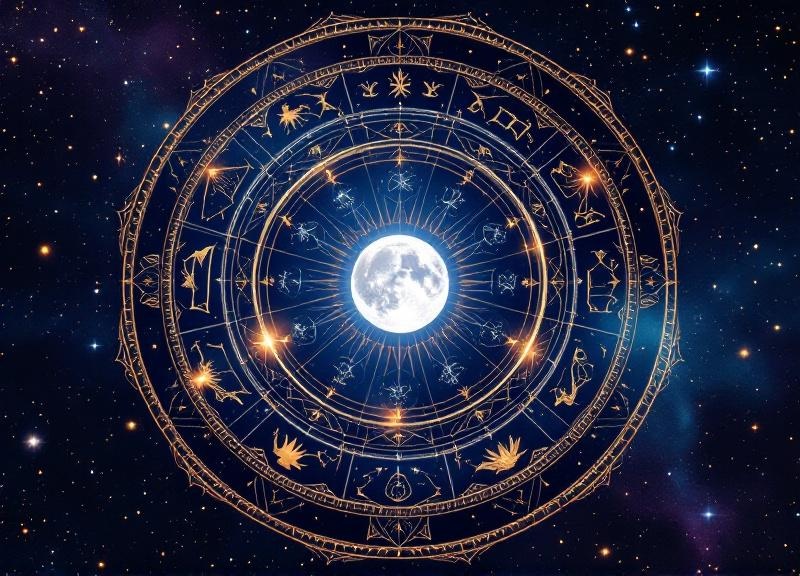
This is where Jyotish offers something truly unique. Beyond the 12 Moon signs, Vedic astrology divides the Moon's path into 27 nakshatras (lunar mansions), each spanning 13 degrees and 20 minutes, each carrying a distinct deity, shakti (power), and psychological signature.
Consider: two individuals may both have Moon in Taurus. But one is born with Chandra in Rohini nakshatra — presided over by Brahma, deeply sensory and aesthetically inclined, described in classical texts as "fond of beauty, eloquent, steady." The other carries the Moon in Mrigashira nakshatra — ruled by Soma, restless, perpetually searching for something just beyond reach, with curiosity that borders on anxiety.
Same sign. Entirely different inner lives.
The nakshatra also determines which planetary period (dasha) you begin life in, literally shaping the timing and sequence of your life's unfolding. The Moon's placement doesn't merely describe your emotional nature in Jyotish — it sets the clock of your entire biography.
Moon Signs by Element: Your Emotional Operating System
Here's a quick-reference guide to how the four elements express through the Moon. Remember, these are starting points — your full chart adds layers of nuance.
| Element | Moon Signs | Emotional Style | Core Need | Shadow Pattern |
|---|---|---|---|---|
| Fire | Aries, Leo, Sagittarius | Reactive, passionate, action-oriented | Autonomy and inspiration | The emotions they can't outrun through action |
| Earth | Taurus, Virgo, Capricorn | Steady, sensory, pragmatic | Security and tangible comfort | Equating emotional needs with weakness or something that must be "earned" |
| Air | Gemini, Libra, Aquarius | Analytical, communicative, relational | Understanding and mental stimulation | Intellectualizing feelings instead of feeling them |
| Water | Cancer, Scorpio, Pisces | Absorptive, intuitive, deeply feeling | Emotional depth and authentic connection | Internalizing the message that sensitivity is pathological |
The Jungian perspective adds a valuable insight here: your Moon sign describes not just your emotional style but your shadow material — specifically, what you need but were never fully taught you could ask for. A Capricorn Moon, for instance, often belongs to someone who learned that emotional needs were appropriate only when earned. The developmental invitation is to discover that nurturance is not a reward; it is a right.
Your Moon Sign in Relationships
Most relationship conflict originates not at the Sun level but at the Moon level — in the collision of incompatible emotional blueprints. Two Libra Suns seeking harmony will still struggle profoundly if one carries a Scorpio Moon requiring emotional depth and honest confrontation, while the other's Gemini Moon deflects intensity through wit and intellectual repositioning.
The surface presentation looks similar. The relational need is entirely opposed.
This is why compatibility analysis that accounts for Moon signs — and in Vedic tradition, kundli matching that examines the Moon's nakshatra alignment — reveals dynamics that Sun-sign comparison simply misses. Your Moon sign is, in many ways, the most honest thing about how you love and what you need in return.
Practical Ways to Work With Your Moon Sign
The 28-Day Moon Journal
For one complete lunar cycle, note your emotional tone each morning before you check your phone — before you construct your social presentation. Notice what you need before you've translated that need into something acceptable. Over time, patterns emerge that are unmistakably your Moon's signature: the recurring longing, the automatic withdrawal, the specific texture of your stress response.
The One Question Practice
Sit with this during the coming new Moon: What do I reach for when I feel unsafe? Not what you think you should reach for. What you actually reach for, automatically, before the rational mind arrives. Write it down without judgment. Then ask: is this reaching nourishing me, or simply familiar?
Tailor the practice to your Moon's element:
- Earth Moons: Do this with your hands occupied — walking, kneading bread, tending something physical.
- Air Moons: Write it out in a letter you will never send.
- Water Moons: Sit near water, literal or imagined.
- Fire Moons: Move first, write after.
Vedic Remedies for a Challenged Moon
From the Jyotish tradition, if your Moon is weakened — debilitated in Scorpio, hemmed by malefics, or placed in the 6th, 8th, or 12th house — specific remedies can help stabilize the Manas. Classical prescriptions include reciting the Chandra Beeja mantra (Om Shram Shreem Shroum Sah Chandramasay Namah) on Mondays during the waxing fortnight, wearing a natural pearl set in silver, and offering white foods — rice, milk, white flowers — to those in need on Monday evenings. A personalized birth chart reading can help you assess Chandra's dignity in your chart.
The Sidereal vs. Tropical Question You Need to Know About
Here's the honest caveat that most astrology platforms quietly sidestep: because of the roughly 24-degree difference between the tropical (Western) and sidereal (Vedic) zodiacs, a significant number of people will have different Moon signs depending on which system they use. Your Western Taurus Moon may be, in Jyotish terms, an Aries Moon.
Neither system is "wrong." The Western system maps your emotional experience onto seasonal archetypes; the Vedic system locates you within the actual star field. Both are true, the way a map of roads and a map of terrain are both true. Use both, and you triangulate something closer to lived reality. Our calculators can help you explore both placements.
A Note on Evidence
Intellectual honesty matters here. The astrological community often cites user surveys showing that people find Moon sign descriptions more accurate than Sun sign descriptions. That reflects real perceived resonance — but it is sentiment data, not controlled empirical evidence. The strictly scientific literature has not confirmed a measurable correlation between Moon sign placement and personality traits. What is well-supported is that frameworks emphasizing emotional pattern recognition, early attachment conditioning, and stress-response mapping offer genuine therapeutic benefit. Whether the Moon sign functions as an accurate celestial indicator or as a powerful symbolic tool that helps people access these patterns is a genuinely open question. Both things can be true simultaneously, and you're allowed to hold that tension.
Frequently Asked Questions
Is my Moon sign more important than my Sun sign?
It depends on which tradition you're asking. Vedic astrology would say yes — unequivocally. Chandra (the Moon) governs the Manas (mind), and the entire dasha timing system flows from the Moon's nakshatra. Western astrology treats both as essential but increasingly recognizes the Moon's primacy in emotional and relational matters. If you want to understand your inner life, start with the Moon. If you want to understand your life direction, the Sun has plenty to say.
Can two people with the same Moon sign have very different emotional personalities?
Absolutely. The Moon's house placement, its aspects to other planets, and — in Vedic astrology — its nakshatra all create enormous variation within a single Moon sign. Two Cancer Moons can feel profoundly different if one sits in the 10th house conjunct Saturn and the other rests in the 4th house with Jupiter's blessing.
Why might my Moon sign description not resonate with me?
A few possibilities: you may be reading a description based on the tropical zodiac when your sidereal Moon sign is different, your Moon may be heavily aspected by other planets that modify its expression, or you may be identifying more with your Sun or rising sign because they're more visible in daily life. The Moon often describes what you need rather than what you show — it can take honest reflection to recognize it.
How do I find my Moon sign if I don't know my exact birth time?
Because the Moon changes signs approximately every 2.5 days, you can sometimes determine your Moon sign even without a precise birth time — unless you were born on a day the Moon shifted signs. In that case, you'll need at least an approximate birth time. A birth chart tool will flag this for you.
What's the best way to use my Moon sign in daily life?
Track the transiting Moon through your chart each month. When it crosses your natal Moon's position — your lunar return — notice what surfaces. These aren't random moods; they're invitations to relationship with your own interior life. You can also check your daily horoscope for both your Sun and Moon sign to get a fuller picture.
Frequently Asked Questions
What is a Moon sign and how is it different from a Sun sign?
Your Moon sign is the zodiac sign the Moon occupied at the exact moment of your birth, and it tends to describe your emotional instincts rather than your outward identity. The Sun sign reflects the persona you build over time, while the Moon sign often reveals how you react before conscious thought kicks in -- the gut response, the comfort-seeking, the private inner life.
Do I need my exact birth time to find my Moon sign?
Birth time matters quite a bit for the Moon, since it moves through a full zodiac sign roughly every two and a half days. Without a recorded birth time, you may land on a sign boundary and feel uncertain which applies. A professional astrologer can sometimes use a technique called chart rectification, though results are estimates rather than certainties.
Why does my Moon sign feel more accurate than my Sun sign?
Many people find the Moon sign hits closer to home because it often describes emotional texture -- how you privately feel, what soothes you, what unsettles you -- rather than aspirational traits. The Sun describes who you are working to become, while the Moon tends to reflect patterns already wired in, sometimes uncomfortably familiar once named.
What is the difference between a tropical Moon sign and a sidereal Moon sign?
Tropical astrology, common in the West, anchors the zodiac to the seasons, while sidereal astrology, used in Vedic traditions, aligns it to the observable star positions. The two systems can place your Moon in different signs -- sometimes the same, often one sign apart. Neither is objectively correct, but each operates within a different interpretive tradition.
Can two people with the same Moon sign really have similar emotional needs?
There is often a recognizable thread, yes -- a shared emotional tone or default coping style. A Moon in Scorpio, for instance, tends toward intensity and privacy across many different charts. That said, the full chart, life experience, and cultural context shape how those patterns actually surface, so resemblance is real but rarely identical between two people.
Ready to explore your cosmic blueprint?
Discover what the stars reveal about your unique path.
Explore Zodiac Compatibility

