Full Moon Rituals: Release, Reflect & Recharge Monthly
By Deluxe Astrology

What the Full Moon Actually Is (And Why It Matters)
Every 29.5 days, the Sun and Moon reach exact opposition in the sky. The Moon reflects the full force of solar light back toward Earth, and for a night or two, the darkness recedes. That is the astronomy. But cultures across every inhabited continent, for thousands of years, have insisted this moment is more than geometry.
They might be right — and not just for mystical reasons. A 2013 study published in Current Biology found that subjects sleeping in controlled environments with zero visual access to the sky still slept an average of 20 minutes less around the full moon, with measurably reduced melatonin. A 2021 study in Science Advances confirmed statistically significant disruptions to slow-wave sleep near the lunar peak. Your body registers this shift whether or not you own a single crystal.
The ancient instinct to mark the full moon with ritual — fasting, reflection, ceremony, release — is a coherent cultural response to a real physiological signal. The question is not whether the full moon means something. It is whether your current practice is deep enough to meet it.
Where Every Tradition Agrees
Here is the rare point of near-total consensus across Vedic, Western, Chinese, and folk traditions: the full moon is a time to complete, not to begin. The lunar cycle tells a story. The new moon is the opening scene — potential, shadow, quiet intention. The full moon is the climax. Something must be named, faced, or let go. The waning weeks that follow are integration time, the slow exhale.
In Vedic astrology (Jyotish), the full moon is called Purnima — and it is treated as a day when the mind (manas) reaches maximum receptivity. Every impression lands deeper. Classical texts recommend fasting, charity, and extended meditation because the mind is wide open, for better or worse.
In Western psychological astrology, the Full Moon activates what Jungian analysts call the transcendent function — the psyche's ability to hold two opposing truths simultaneously. The Sun represents your conscious ego; the Moon holds everything the ego has not yet integrated. At opposition, they face each other directly. What you have been avoiding becomes visible.
In Daoist tradition, the full moon represents yin maximization — fullness reaching its natural tipping point toward decrease. Release is not loss. It is cooperation with what was always going to happen.
The cosmic consensus is clear: this is not the time to launch new projects or plant new seeds. It is the time to see clearly, harvest what is ripe, and let go of what has finished its cycle.
Key takeaway: Every major tradition treats the full moon as a moment of revelation and completion. If your full moon ritual focuses on starting something new, you are working against the current.
The Nakshatra Factor Most People Miss
This is where things get genuinely interesting — and where most modern full moon content falls short.
Contemporary practice tends to focus on the zodiac sign the full moon falls in. "Full Moon in Scorpio — time for deep release!" But from a Vedic lens, the nakshatra (lunar mansion) the Moon occupies matters at least as much, and often more. Vedic astrology divides the sky into 27 nakshatras, each carrying a specific deity, quality, and psychological theme.
A Full Moon in Scorpio sounds uniformly intense. But if it falls in Anuradha nakshatra, ruled by Mitra (the deity of friendship and devotion), the emotional charge is warm, connective, relational. If it falls in Jyeshtha nakshatra, associated with power struggles and hidden authority, the energy is entirely different — more protective, more demanding.
Classical Jyotish names each Purnima according to its nakshatra and month — Kartik Purnima, Vaishakha Purnima, Sharad Purnima — and each carries specific mantras, presiding deities, and recommended practices. Sharad Purnima, occurring in autumn, is considered the most potent full moon of the entire year. Classical texts describe the Moon as dispensing amrita (nectar of immortality) through her rays on this night, and the traditional practice of placing milk or rice pudding under the open sky reflects this understanding.
Most Western practitioners are reading the chapter heading without reading the chapter. Even a basic awareness of which nakshatra is active at each full moon transforms generic release work into something far more precise.
You can find the nakshatra for any full moon using a Vedic ephemeris or your birth chart calculator set to the sidereal zodiac.
Key takeaway: The nakshatra active during a full moon determines its specific quality and flavor. Not all full moons are created equal — and knowing the nakshatra gives you a much more accurate map.
Full Moon as Psychological Mirror
The Jungian perspective offers something that purely spiritual frameworks sometimes skip: unflinching honesty about what the full moon actually surfaces.
Liz Greene, whose work in psychological astrology remains foundational, describes the Moon as the "ocean of feeling" beneath the rational surface. At the full moon, that ocean is illuminated rather than hidden. This is not always pleasant. The archetype activated is one of revelation — the kind that carries real developmental weight.
Each month's full moon falls across a specific zodiacal axis, activating a particular polarity in your chart. A Full Moon in Virgo/Pisces asks you to hold practical discernment and sacred surrender simultaneously. Taurus/Scorpio brings material security into confrontation with psychological depth. These polarities are not arbitrary — they correspond to genuine developmental tensions.
Here is the uncomfortable part: because the Moon rules our relational patterning — the early conditioning around need, nurturance, and emotional safety — full moon periods frequently amplify interpersonal friction. The Jungian view is that the people who provoke you most intensely around a full moon are often mirroring something you have not yet owned in yourself. The relational friction is data, not noise.
This creates an interesting tension with the Vedic approach. Jyotish says: the full moon is a time of heightened shakti; channel it through mantra, fasting, and devotion. Jungian psychology says: the full moon surfaces shadow material; sit with it, witness it, do not rush to perform it away. Both are true. The question is which emphasis serves you in a given month — and that may depend on your current dasha period, your natal Moon's condition, or simply where you are in your life.
Key takeaway: The full moon illuminates what you have been avoiding. The most productive response is often honest self-observation before you reach for any ritual tool.
What the Science Actually Says
Intellectual honesty matters here. Studies specifically testing astrological claims about full moons and emergency room visits, birth rates, or psychiatric episodes have consistently failed to show significant correlation. The moon appears to affect sleep architecture more than mood directly.
This leads to a provocative possibility from the sociological perspective: the reflective, emotionally heightened quality traditionally assigned to full moons may derive in part from accumulated sleep disruption rather than purely mystical correspondence. You are slightly sleep-deprived. Your defenses are down. Unconscious material rises more easily.
Whether you call that biology or cosmic design — and a strong case can be made for both — the practical implication is the same: you are genuinely experiencing something different in your body at the full moon. The impulse to ritualize that shift is pattern recognition, not superstition.
A Full Moon Ritual That Honors the Depth
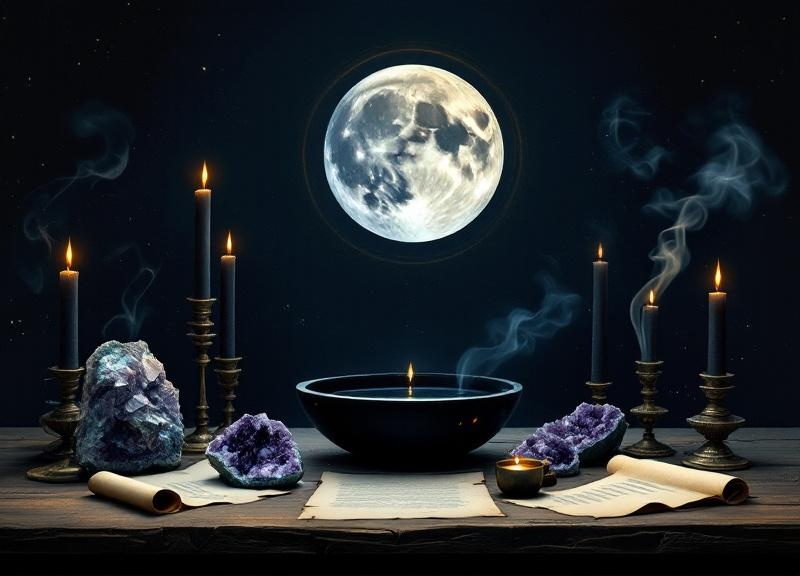
Drawing from multiple traditions, here is a full moon practice that goes beyond the surface:
Three Days Before: Inventory
Not journaling — an inventory. List what you have been carrying that no longer belongs to this chapter: beliefs, resentments, identities that were once useful and have now calcified. If you are in a Chandra Mahadasha or Antardasha (Moon major or sub-period in Vedic astrology), this inventory will land with particular force. Check your birth chart for current dasha periods.
Day of the Full Moon: Voice and Release
- Begin with the body. Spend five to ten minutes tracking physical sensation. Where does your body hold tension, aliveness, contraction? The body processes unconscious material faster than the mind.
- Shadow mapping. List three people or situations from the past two weeks who provoked a strong reaction — positive or negative. Ask honestly whether the quality you responded to most strongly lives somewhere in you, unacknowledged.
- Speak and release. Read your inventory aloud under open sky if possible. Speaking activates what the Vedic tradition calls vak — the power of voiced intention. Then burn the list, tear it, or release it into moving water.
- Optional Vedic addition: Offer arghya (water offering) toward the rising Moon while chanting the Chandra Beej Mantra: Om Shram Shreem Shroum Sah Chandraya Namaha — 108 repetitions.
- Dietary awareness. Classical texts recommend avoiding meat, alcohol, and heavy foods on Purnima. Your digestive fire and emotional body both run heightened; what you consume circulates with unusual speed.
Three Days After: Reception
Practice reception rather than action. Let the waning light carry what you released. Do not immediately fill the space with new goals or intentions. That is new moon work.
For those with an afflicted natal Moon (conjunct Rahu, Ketu, or Saturn in your birth chart), Purnima is considered the ideal day for dana (charity): donating white foods — rice, milk, white cloth — or silver.
Quick Reference: Full Moon Rituals by Tradition
| Tradition | Core Principle | Primary Practice | Unique Emphasis |
|---|---|---|---|
| Vedic (Jyotish) | Mind at maximum receptivity | Mantra, fasting, charity, arghya | Nakshatra-specific; dasha-sensitive |
| Western Psychological | Conscious/unconscious confrontation | Shadow mapping, active imagination journaling | Sign axis polarity; projection work |
| Daoist/Chinese | Yin maximization; natural tipping point | Release as cooperation with cycle | Non-resistance; flow with decrease |
| Folk/Contemporary | Pause and recalibrate | Moon water, journaling, candle ritual | Accessibility; personal adaptation |
Frequently Asked Questions
Can I do full moon rituals if I do not know my birth chart?
Absolutely. The monthly lunar cycle affects everyone — you do not need your natal chart to benefit from pausing, reflecting, and consciously releasing on the full moon. That said, knowing your natal Moon sign, its nakshatra, and which houses the full moon activates in your chart adds real specificity. You can generate a free chart at our birth chart tool to get started.
Is every full moon the same, or do they vary?
They vary enormously. Each full moon falls in a different zodiac sign and — critically — a different nakshatra (Vedic lunar mansion). A Purnima in Rohini nakshatra carries fertile, creative energy; one in Jyeshtha demands careful, protective practice. The sign axis tells you the theme. The nakshatra tells you the specific quality. Treat each full moon as its own event.
Should I set new intentions on the full moon?
Across traditions, the answer is consistent: the full moon is for completion, not initiation. Save your intention-setting for the new moon. The full moon is better used for honest assessment of what has ripened and what needs to be released. If you are checking your daily horoscope around the full moon, pay attention to what themes are surfacing — those are your cues for release, not for launch.
What if the full moon feels overwhelming instead of magical?
That is completely normal and, from a psychological standpoint, potentially the most productive response. If you are running a Saturn or Rahu dasha in Vedic terms, or if your natal Moon has challenging aspects, the full moon may surface unresolved material rather than offering easy uplift. The wiser approach in those periods is purification and compassionate self-observation rather than expansion rituals. Charity and grounding practices — donating white foods, spending time in nature — are recommended by classical texts for exactly these situations.
Does the full moon actually affect relationships?
Both Vedic and Western traditions say yes — though they explain it differently. Jyotish holds that the heightened mind absorbs impressions more deeply, intensifying emotional exchanges. Jungian psychology suggests that projections intensify: the people around you may seem to embody exactly the qualities you are refusing to own. Either way, the practical advice is the same — bring extra awareness to your interactions around the full moon, and check your compatibility insights if a specific relationship keeps activating around lunar peaks.
Ready to explore your cosmic blueprint?
Discover what the stars reveal about your unique path.
Generate Your Birth Chart

