Astrology & Mental Health: Birth Chart Emotional Patterns
By Deluxe Astrology

Your Birth Chart Is an Emotional Blueprint
Every tradition that has ever looked skyward — Vedic, Western, Chinese — arrived independently at the same fundamental insight: the moment of your birth imprints you with particular emotional tendencies, vulnerabilities, and gifts. Your birth chart doesn't sentence you to anything. It describes you. There is a profound difference.
Classical Jyotish never separated the mind from the cosmos. The ancient text Brihat Parashara Hora Shastra dedicates entire chapters to manas (mind) and chitta (consciousness), treating them as planetary phenomena just as much as psychological ones. Western psychological astrology, drawing from the work of Liz Greene and Howard Sasportas, frames the chart as a map of the psyche — not a prediction of fate, but a portrait of the archetypal energies running through your life.
And here's the cultural moment we're in: a 2022 YouGov survey found that 27 percent of Americans believe in astrology, with the highest concentrations among Millennials and Gen Z — the same demographics driving the growth of therapy culture and emotional literacy conversations. Search interest for terms combining astrology with anxiety, depression, and self-care has increased by over 300 percent since 2018. People are reaching for frameworks that help them name and normalize emotional experience. Your birth chart might be one of the most ancient frameworks available.
The question worth sitting with is not whether astrology can replace therapy — it cannot, and any responsible practitioner will say so plainly. The question is whether a birth chart can offer something genuinely useful for understanding your emotional patterns. Across traditions and centuries, the answer is a quiet, insistent yes.
The Moon: Where Your Emotional Life Begins
If every astrological tradition agrees on one thing about mental health and the birth chart, it's this: start with the Moon.
In Western astrology, your Moon sign carries the archetype of the nurturing matrix — what you absorbed in earliest life before language, before conscious memory. It describes not simply what you feel, but how you feel. A Moon in Capricorn operates through emotional containment and self-sufficiency, often because early experiences suggested that need was dangerous. A Moon in Pisces dissolves boundaries instinctively, seeking merger as emotional safety. Neither is pathology. Both are adaptations.
Vedic astrology goes further. In Jyotish, the Moon — called Chandra — governs the mind with absolute primacy. Your Janma Rashi (the Moon's sign at birth) is considered more personally revealing than your Sun sign. Where Western astrology often privileges the Sun as the core self, Jyotish places the Moon at the center of psychological identity. Your Moon's position by sign, house, and nakshatra (lunar mansion) describes the texture of your emotional experience: how quickly you are disturbed, how deeply you feel, and how readily you recover.
The Nakshatra Layer: A Vedic Refinement
This is where Vedic astrology offers something Western practice simply doesn't have. The twenty-seven nakshatras each carry a shakti — an elemental power — and a presiding deity whose mythology maps directly onto psychological tendencies.
A Moon in Ashlesha (ruled by Mercury, presided over by the Nagas) describes a mind that clings, suspects, and processes emotions through intense, coiling mental activity. A Moon in Ardra (ruled by Rahu, presided over by Rudra the storm deity) correlates with emotional storms followed by profound transformation — the grief-and-renewal cycle that classical commentators recognized as both a wound and a gift.
If you've ever felt like your zodiac sign description only told half the story, the nakshatra of your Moon might hold the missing half.
Key takeaway: Both traditions agree — your Moon placement is the single most important indicator of emotional patterning. The sign tells you how you feel, the house reveals where you feel most acutely, and the aspects show what interrupts or amplifies your emotional life.
Saturn: The Inner Critic Written in the Stars
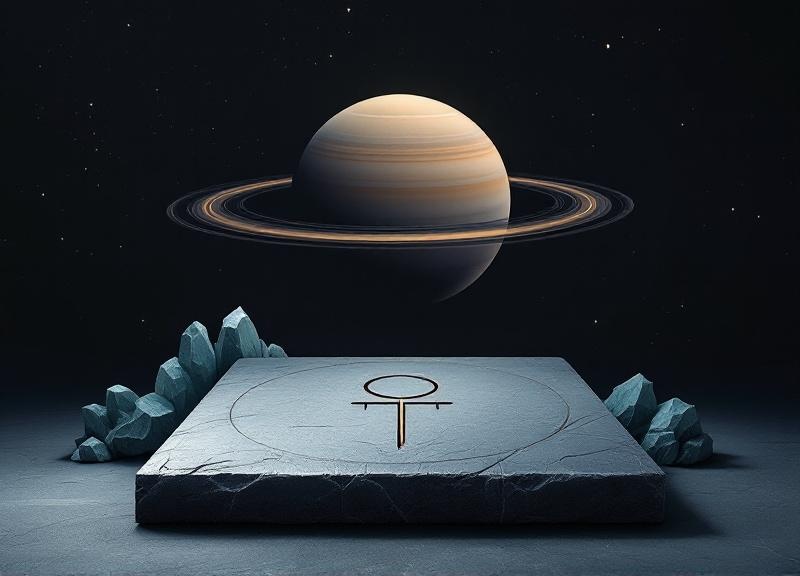
If the Moon describes your emotional needs, Saturn describes the voice that tells you those needs are too much.
The Jungian perspective frames Saturn as the internalized critic — the psyche's built-in compliance mechanism shaped by experiences of judgment, conditional love, or perceived inadequacy. Wherever Saturn falls in your chart, you encounter the archetype of the Senex: demanding, withholding, insisting on proof before granting worth. This is often where the inner critic lives, repeating scripts that once belonged to parents, teachers, or other authority figures.
Saturn square the Moon is a particularly potent signature across both traditions. In Western psychological astrology, it correlates with the feeling that one's emotional needs are burdensome or unacceptable — a pattern traced directly to early conditioning. In Vedic astrology, when Saturn aspects the Moon through its third, seventh, or tenth aspect, the result is described as Visha Yoga, literally a "poisoning of the mind." Classical texts describe tendencies toward pessimism, self-criticism, and excessive rumination.
But here's what the Vedic tradition insists on, and it's worth hearing: this is not doom. The soul carrying this combination is being asked to develop extraordinary discipline and equanimity, not to suffer without purpose. Saturn's pressure creates diamonds — that's not a platitude in Jyotish, it's a philosophical principle.
The traditions converge on a powerful image: Saturn near the Moon means you likely learned to ration your own softness.
Neptune: The Blurred Edge Between Feeling and Fleeing
Here's where the traditions part ways, and the tension is worth preserving.
Neptune is a distinctly Western astrological concept — it has no direct Vedic equivalent. In Western practice, Neptune activates the archetype of dissolution and transcendence. In healthy expression, it offers access to compassion, creativity, and spiritual depth. In its shadow, Neptune operates through escapism, idealization, and the blurring of self-other boundaries.
When Neptune makes hard aspects to the Sun or Moon, individuals frequently report a persistent sense of unreality, difficulty trusting their own perceptions, or a pull toward substances, fantasy, or relationships that serve as chemical substitutes for genuine self-connection. Neptune's continued transit through Pisces until 2026 amplifies these themes culturally — think social media dissociation, parasocial relationships, and the collective difficulty distinguishing information from feeling.
Vedic astrology doesn't have Neptune, but it does have Rahu — the north lunar node — which functions as a partial analog. Rahu represents obsession, illusion, and insatiable craving. When Rahu afflicts Mercury in a Vedic chart, the classical texts describe buddhi dosha — a corruption of discriminative intelligence manifesting as anxious thinking, obsessive loops, or distorted perception. The overlap with Neptune's shadow is striking, even if the frameworks differ.
Key takeaway: If you feel chronically drawn to checking out — through substances, scrolling, fantasy, or over-busyness — look at Neptune aspects in your Western chart and Rahu's condition in your Vedic chart. Both point toward where you lose yourself.
Does This Actually Work? The Honest Tension
Intellectual honesty requires a harder look here, and we're not going to skip it.
The scientific literature on astrology's predictive validity for personality is largely unfavorable. The most cited study remains the Shawn Carlson double-blind experiment published in Nature in 1985, in which professional astrologers performed no better than chance at matching birth charts to psychological profiles. A 2003 "time-twin" study by Geoffrey Dean and Ivan Kelly, tracking over 2,000 individuals born within minutes of each other, found no significant correlation in personality, intelligence, or life outcomes.
What research does support is the therapeutic utility of symbolic frameworks themselves. Narrative therapy and Jungian analysis both demonstrate that giving language and story to emotional patterns improves self-awareness and coping capacity. If identifying Saturn squaring your Moon as a symbol for your critical inner voice helps you externalize and examine that voice, the mechanism is the symbol working — regardless of whether the celestial body is the direct cause.
Carl Jung himself corresponded with astrologer Dane Rudhyar and found astrology useful as a projective system — a symbolic language for surfacing unconscious patterns — even though his own empirical experiments with it yielded statistically unremarkable results.
You can hold both truths: that empirical evidence for astrological specificity remains weak, and that the birth chart as a tool for emotional self-reflection has genuine psychological utility. The two are not mutually exclusive, and pretending you must choose one is a false binary.
Key Planetary Signatures at a Glance
| Planetary Pattern | Emotional Tendency | Vedic Perspective | Western Perspective | Practical Response |
|---|---|---|---|---|
| Moon-Saturn hard aspect | Self-criticism, emotional restriction | Visha Yoga — "poisoning" of the mind; builds discipline | Inner critic; anxious or avoidant attachment patterns | Track the critical voice; ask "whose voice is this originally?" |
| Moon-Rahu conjunction | Obsessive emotional patterns, craving | Graha Dosha — mental agitation, distorted perception | Compulsive emotional intensity (North Node conjunct Moon) | Grounding practices; conscious boundary-setting |
| Moon-Neptune hard aspect | Escapism, boundary dissolution, idealization | No direct equivalent (Rahu as partial analog) | Spiritual hunger misdirected; substance susceptibility | Track avoidance impulses for two weeks; identify the bypassed feeling |
| Afflicted Mercury | Anxious thinking, obsessive mental loops | Buddhi Dosha — corruption of discriminative intelligence | Overthinking, mental restlessness | Vedic: Mercury mantra on Wednesdays. Western: journaling practice |
| Saturn in the 4th house | Difficulty with inner peace, emotional security | Challenges to sukha (happiness); karmic family patterns | Early home environment shaped by restriction or duty | Consciously create safety in your home environment |
Practical Ways to Work With Your Chart
From the Western Psychological Tradition
- Locate your Moon sign and house in your birth chart. Journal about the emotional needs that placement describes — then examine honestly whether you allow those needs to be met.
- Identify Saturn's house position and write out the critical inner narrative active in that area of life. Whose voice is it originally?
- Note any Neptune-Moon aspects and track, over two weeks, moments you reach for avoidance — substances, fantasy, doom-scrolling — as a way of locating what genuine feeling is being bypassed.
From the Vedic Tradition
- For Moon-Saturn afflictions, the classical remedy is Chandra mantra recitation: Om Som Somaya Namah, chanted on Monday evenings, ideally facing the rising Moon. Wearing pearl or moonstone set in silver is traditionally prescribed to strengthen the Moon's benefic qualities. (Visit our crystals guide for more on gemstone remedies.)
- For Mercury afflictions producing anxious thought patterns, Om Bum Budhaya Namah on Wednesdays is recommended, combined with acts of charitable service — seva — which redirects Saturn's contracting energy into its highest expression.
A Cross-Tradition Monthly Practice
On the night of each New Moon, pull up your chart and notice which house the current New Moon activates. Write one sentence — not a paragraph, one sentence — about what you need emotionally in that area of life. Read it aloud. This is a spoken contract between your conscious mind and your emotional blueprint, renewed monthly with the sky's own rhythm.
Frequently Asked Questions
Can my birth chart diagnose a mental health condition?
No — and any astrologer who claims otherwise is overstepping. Your birth chart can reveal emotional patterns and tendencies, but it is not a clinical diagnostic tool. Think of it as a symbolic map that can complement therapy, not replace it. If you're experiencing significant mental health challenges, a qualified therapist should be your first call.
Is my Moon sign more important than my Sun sign for understanding emotions?
Both traditions lean strongly toward yes. In Vedic astrology, the Moon sign (Janma Rashi) is considered the primary indicator of psychological identity. Western psychological astrology also treats the Moon as the core of your emotional operating system. Your Sun sign describes your conscious identity and vitality; your Moon sign describes how you actually feel when no one is watching.
What if my chart shows a lot of Saturn-Moon tension? Am I doomed to depression?
Absolutely not. Both Vedic and Western traditions emphasize that challenging placements describe patterns, not permanent sentences. The Vedic tradition specifically frames Saturn-Moon tension as a call to develop extraordinary equanimity and inner strength. In Western psychological astrology, it's an invitation to make the inner critic conscious — which is the first step toward freedom from it. Timing matters too: the Vedic Vimshottari Dasha system shows when these patterns activate most intensely and when natural windows for healing open.
Is there scientific proof that astrology affects mental health?
The empirical evidence for astrological specificity — that your Moon sign predicts your emotional patterns more accurately than chance — remains weak by conventional scientific standards. What research does support is the therapeutic power of symbolic frameworks. Giving language and story to emotional patterns improves self-awareness and coping, whether that language comes from astrology, narrative therapy, or Jungian analysis. You can take astrology seriously as a reflective tool without claiming it operates through scientifically verified mechanisms.
How do I find my Moon sign and Saturn placement?
You'll need your exact birth time, date, and location. Use our free birth chart calculator to generate your full natal chart, which will show your Moon sign, Saturn placement, and all the aspects discussed in this article. For the Vedic (sidereal) perspective, make sure to check the option for the Vedic chart, as the sign placements will often differ by about 23 degrees from the Western (tropical) calculation.
Ready to explore your cosmic blueprint?
Discover what the stars reveal about your unique path.
Generate Your Birth Chart

