What Is Nadi Astrology? Complete Guide to Palm Leaf Readings
By Ravi Khorana

The Cosmos as Library
Most astrological traditions hand you a chart and say, "Here's the sky at your birth — let's interpret it together." Nadi astrology does something radically different. It says: a sage already interpreted it. Thousands of years ago. And he wrote it down on a palm leaf with your name on it.
That's either the most extraordinary claim in the history of divination or an audacious act of cultural imagination. Probably, as with most things worth thinking about, it's both.
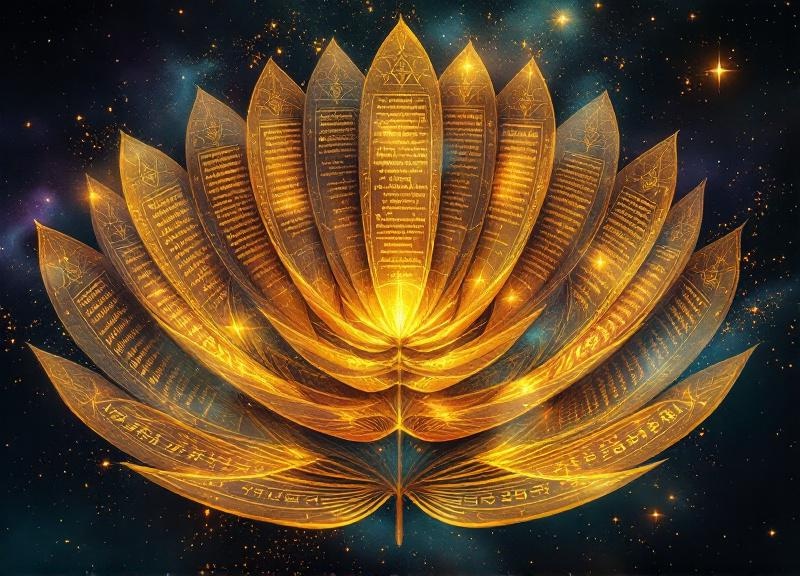
The Nadi Shastra (nāḍi śāstra) tradition centers on the belief that the Saptarishis — the seven great sages of Vedic tradition, including Agastya, Bhrigu, and Vashishtha — perceived the full arc of every soul's journey across lifetimes while in states of deep meditative absorption (samadhi). They inscribed these visions onto dried palm leaves in archaic Tamil script. These leaves have been preserved, copied, and passed through hereditary lineages for centuries, most prominently near Vaitheeswaran Koil (Vaitheeswaran Temple) in Tamil Nadu.
This isn't astrology as interpretation. It's astrology as record retrieval. As one cross-tradition observer put it beautifully: this is not the cosmos as clockwork — this is the cosmos as library.
How Nadi Astrology Actually Works
The entry point to a Nadi reading isn't your birth time or rising sign. It's your thumb impression — right thumb for men, left for women. The ridges and whorls of your thumbprint are classified into a finite set of types, each corresponding to a specific bundle of palm leaves called a naadi olai.
From a Vedic perspective, this isn't arbitrary. The thumb's dermatoglyphic patterns are understood to map onto the nadi channels — the same subtle energetic pathways recognized in Ayurvedic pulse diagnosis. Your thumbprint, in this framework, is the unique energetic signature of your soul's accumulated karma. Western palmistry, interestingly, assigns the thumb a parallel significance: it represents personal will and force. The bureaucratic-seeming act of pressing your thumb onto a card is, symbolically, you declaring: I am this specific accumulation of cause and effect. Show me my record.
Once the thumb type narrows down the leaf bundle, the Nadi Shastrakar (reader) begins reading through candidate leaves, asking verification questions — your parents' names, number of siblings, current life circumstances. Only when you confirm a match does the full reading begin.
This verification process is also where the tradition's biggest controversy lives — but we'll get to that.
The 14 Kandams Explained
The heart of any authentic Nadi reading is the 14-Kandam structure — fourteen chapters that together form a comprehensive map of a human life. The word kāṇḍam means "section" or "chapter," and each one addresses a specific domain.
| Kandam | Domain | Approximate Vedic House Parallel |
|---|---|---|
| 1st — Lagnam | General life overview, character, destiny | 1st House (Ascendant) |
| 2nd | Wealth, family, education | 2nd House |
| 3rd | Siblings, courage, short journeys | 3rd House |
| 4th | Mother, property, home life | 4th House |
| 5th | Children, creativity, past-life merit | 5th House |
| 6th | Health, enemies, obstacles | 6th House |
| 7th | Marriage, partnerships | 7th House |
| 8th | Longevity, transformation, hidden matters | 8th House |
| 9th | Father, fortune, dharma, foreign travel | 9th House |
| 10th | Career, public life, authority | 10th House |
| 11th | Gains, elder siblings, fulfilled desires | 11th House |
| 12th | Losses, moksha, foreign lands | 12th House |
| 13th — Shanti | Past-life karma and specific remedies | No direct parallel |
| 14th — Diksha | Spiritual initiation and liberation | No direct parallel |
The first twelve Kandams map almost directly onto the twelve-house system you'd find in a standard Vedic birth chart. But the 13th and 14th Kandams are where Nadi becomes something else entirely.
The 13th Kandam (Shanti Kandam) prescribes specific parihara — remedial measures for karmic debts. These aren't generic suggestions. They may include rituals at a precise temple, tarpanam (water offerings to ancestors), specific charitable acts, or mantra recitation. The 14th Kandam (Diksha Kandam) addresses spiritual initiation and the path toward moksha — liberation from the cycle of rebirth.
Here's what's philosophically fascinating: even in a tradition built on the premise of pre-written destiny, these final chapters essentially say, "And here's how to rewrite it." The sage who wrote your leaf apparently also wrote the instructions for changing course. The Jungian perspective would call this the tension between fate and individuation. The Vedic tradition simply calls it karma — not a fixed sentence, but a trajectory that conscious, aligned action can modify.
Key takeaway: The 14-Kandam structure works as a comprehensive life-domain framework whether or not you ever seek an actual Nadi reading. Consider using it as a structured self-inventory — most people find two or three domains chronically neglected in their self-reflection.
Where Experts Agree — and Disagree
When scholars, psychologists, and cultural observers examine Nadi astrology, they converge on certain points and diverge sharply on others. The honest picture requires holding both.
Where they agree
- The manuscript tradition has genuinely ancient roots. The Thanjavur Saraswati Mahal Library historically housed Nadi collections, and custodianship has passed through hereditary Tamil families for generations.
- The 14-Kandam system is an elegant and comprehensive framework for examining life domains — regardless of one's position on the metaphysical claims.
- Commercial fraud is a real and documented problem. Every serious tradition-holder acknowledges this, and it does not invalidate the authentic tradition any more than bad therapists invalidate psychotherapy.
- Nadi belongs to a global class of oracular traditions — alongside the Delphic Oracle, the I Ching, and Tibetan mo divination — where the transmission matters more than the mechanism.
Where they diverge
The sharpest disagreement concerns the verification process. From a traditional Vedic standpoint, the question-and-answer dialogue is part of the reading's authenticity test — the reader is matching, not mining. From a sociological perspective, the same process is psychologically indistinguishable from cold reading — the practitioner asks qualifying questions, observes reactions, and progressively narrows selections. A 2009 investigation by Indian Skeptic magazine documented instances where the same person received different "matching" leaves on separate visits.
Both observations can be true simultaneously. The tradition may contain genuine ancient elements and the commercial practice may involve substantial fabrication. This is the tension worth sitting with rather than resolving prematurely.
The Jungian perspective adds a third angle: whether or not the leaf is literally pre-inscribed, the psychological experience of having your life "witnessed and recorded by something larger" engages what Jung called the Self archetype in its most numinous form. The therapeutic effect — felt significance in a life that felt arbitrary — is real regardless of the leaf's provenance.
Is Nadi Astrology Real? An Honest Assessment
This question deserves a layered answer, not a simple one.
The manuscript tradition is historically real. Palm-leaf collections exist, some genuinely ancient, preserved across Tamil Nadu. Their place within classical Indian knowledge systems — alongside Ayurveda, Carnatic music, and temple architecture — is well established.
The metaphysical premise is a matter of worldview. Within Vedic epistemology, the claim that advanced rishis in samadhi could perceive the full wheel of time is neither more nor less extraordinary than the broader claim that a birth chart reveals character and life events. No peer-reviewed study has validated the core methodology, but controlled empirical testing of oracular traditions is notoriously difficult to design meaningfully.
The commercial practice requires serious discernment. The gap between the tradition's historical depth and its current commercial operation — particularly online — is wide. Any service that bypasses the verification process entirely or promises instant results should be treated with skepticism.
Digitization may change everything. Indian government initiatives and private foundations have begun photographing and cataloguing palm-leaf manuscripts across Tamil Nadu. Within the next decade, this could create a systematically verifiable archive — either rehabilitating or definitively challenging Nadi's core claims.
How to Approach a Nadi Reading
Whether you're seriously considering a reading or simply curious, here's practical guidance drawn from across traditions:
- If visiting in person, Vaitheeswaran Koil remains the most historically grounded center. Ask about the specific lineage of the reader and how their leaf collections were acquired.
- During the verification process, pay attention to specificity. A genuine leaf match should produce details you haven't provided — parents' names, birth order, major life events. Generic statements applicable to anyone are a red flag.
- If a Shanti Kandam prescribes remedies, approach them with practical humility. Temple visits, charitable giving, and mantra practice carry value independent of any single predictive tradition.
- Cross-reference timing predictions with your Vimshottari dasha (the standard 120-year planetary period cycle) and current transits of Saturn and Jupiter. Convergence across multiple systems carries genuine weight.
- For online readings, verify the practitioner's connection to an actual leaf library. The thumb-impression process can be transmitted digitally, and some reputable Vaitheeswaran Koil-affiliated readers do conduct remote sessions — but the space contains significant fraud.
- Use the 14-Kandam framework as a journaling practice even without a reading. Write honest reflections across all fourteen domains. The structure itself is the gift.
Frequently Asked Questions
How is Nadi astrology different from regular Vedic astrology?
Standard Vedic astrology (Parashari Jyotish) constructs a chart from planetary positions at your birth and interprets it through yogas, dashas, and transits. Nadi Shastra bypasses the interpretive layer entirely — the leaf, if genuine, simply states what is. Think of it as the difference between a doctor diagnosing you from symptoms versus reading your pre-existing medical file. Both are valid approaches; they operate on fundamentally different premises. You can explore your own birth chart to see how the standard approach works.
Can Nadi astrology predict marriage and compatibility?
The 7th Kandam specifically addresses marriage, and the tradition frames relational patterns through a karmic inheritance model — your partnerships reflect unresolved dynamics from previous lives. Whether you call these "karmic patterns" or what attachment theory calls "internal working models," the experience is similar: we repeat dynamics we didn't consciously choose. For a complementary perspective, you might also explore Kundli matching or compatibility analysis.
Can Nadi astrology be done online?
Remote consultations happen widely — practitioners conduct sessions via video call using digitally transmitted thumbprint images. Whether these maintain authentic connection to genuine leaf libraries is something you'll need to investigate for each practitioner individually. The most reliable remote readings come from practitioners with documented affiliations to established Vaitheeswaran Koil lineages.
What's the connection between Nadi astrology and palmistry?
Both traditions read the body as a text — Nadi through the thumbprint's ridge patterns, palmistry through the hand's lines and mounts. In Nadi, the thumbprint is the access key to your Akashic record. In palmistry, the thumb represents will and personal force. They share a philosophical conviction that the body encodes the soul's story.
What should I do if a Nadi reading reveals difficult karma?
Resist two equal-and-opposite impulses: accepting it fatalistically or rejecting it defensively. Instead, treat it as you would a meaningful dream — sit with it and ask, "If this were true, what would it be asking me to see?" The 13th Kandam exists precisely because the tradition believes karma can be worked with, not just endured. Prescribed remedies — temple visits, charitable acts, mantra practice — are not superstitions. They're the tradition's own framework for conscious karmic engagement.
Frequently Asked Questions
What exactly is a Nadi palm leaf reading?
A Nadi palm leaf reading is a consultation based on ancient inscribed leaves said to contain pre-recorded life information for specific individuals. A reader -- traditionally from a hereditary lineage -- locates a leaf matched to you by thumbprint, then interprets archaic Tamil text describing your circumstances, past karma, and possible life themes. The process tends to unfold across multiple sessions covering different life areas.
How do Nadi readers find the leaf that belongs to me?
The search typically begins with your thumbprint, which the reader uses to narrow down a bundle of leaves sharing that classification. From there, the reader reads out statements and asks you to confirm or deny them, gradually zeroing in on the leaf that most closely fits your details. Critics note this process can resemble cold reading, while supporters consider it a genuine filtering system.
Are the original palm leaves thousands of years old?
Most scholars and practitioners acknowledge that the physical leaves in circulation are copies, often centuries old, rather than originals from the sages themselves. Palm leaves deteriorate and require periodic transcription to survive. The tradition holds that the knowledge originates with the ancient Saptarishis, but tracing any single leaf to that era directly is difficult to verify through historical or material evidence.
What are the Kandams in a Nadi reading and why do they matter?
Kandams are the chapters of a Nadi reading, traditionally numbering fourteen, each addressing a specific domain of life such as career, relationships, health, or spiritual practice. After an initial general chapter confirms your identity, you choose which Kandams to explore. They matter because they structure the session so that information about each life area stays organized and focused rather than delivered all at once.
Is Nadi astrology considered reliable enough to make major life decisions?
Most seasoned practitioners caution against treating any reading -- Nadi or otherwise -- as a fixed blueprint for major decisions. A Nadi reading often surfaces themes and tendencies worth reflecting on, but the tradition itself acknowledges free will and karma as intertwined. Using a reading as one thoughtful input alongside your own judgment and practical counsel tends to serve people far better than expecting absolute predictions.
Ready to explore your cosmic blueprint?
Discover what the stars reveal about your unique path.
Get Your Vedic Birth Chart

