January 14 Zodiac Sign: The Ambitious Capricorn with Heart and Purpose
By Deluxe Astrology Team
Quick Facts Table: January 14 at a GlanceAstrological Sign, Astronomical Profile & Symbolic MeaningPersonality Traits: Strengths & Growth Areas
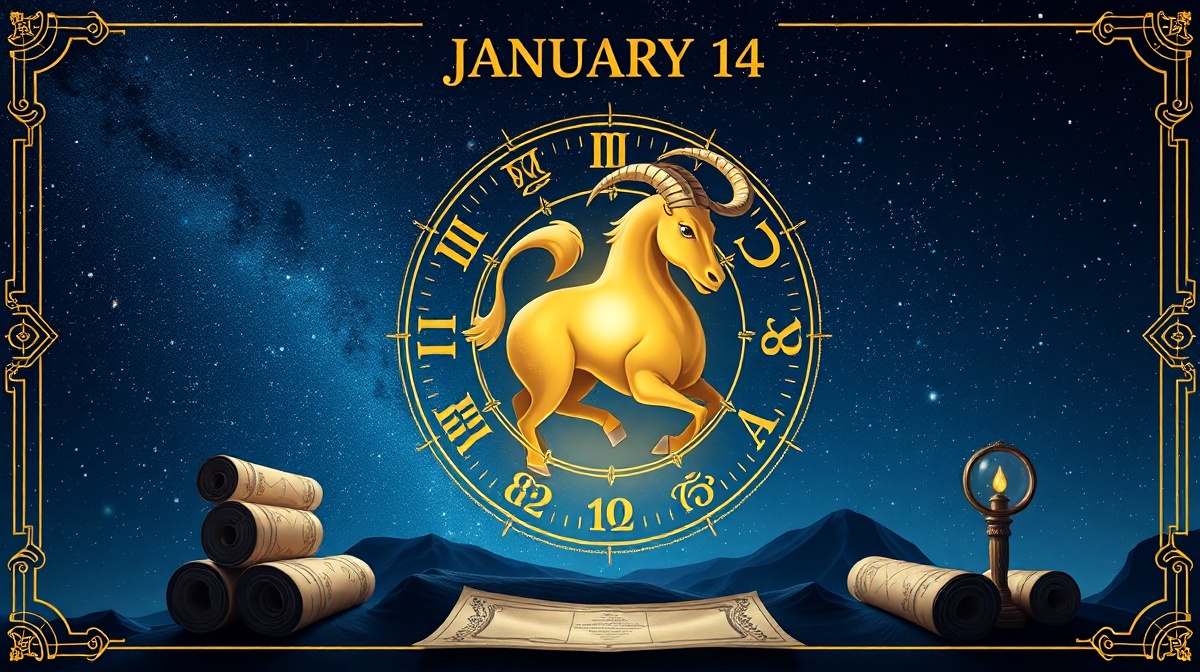
Individuals born on January 14 fall under the astrological sign of Capricorn, a Cardinal Earth star sign ruled by Saturn. Symbolized by the Sea Goat, Capricorns born on this date embody tenacity, structure, and a grounded sense of responsibility. This comprehensive guide explores your astronomical profile, symbolic traits, emotional influences, relationships, gemstones, tarot and numerology, Chinese zodiac connections, and how your birthdate shapes your career, health, and overall life vision.
Quick Facts Table: January 14 at a Glance
Attribute
Details
Zodiac Sign
Capricorn
Element
Earth
Modality
Cardinal
Symbol
Sea Goat (Mountain Goat + Fish)
Ruling Planet
Saturn
Birthstone
Garnet
Complementary Gemstones
Onyx, Black Tourmaline
Lucky Colors
Forest Green, Brown
Lucky Numbers
4, 14, 23
Tarot Card
The Emperor
Angel Number
14
Compatibility
Taurus, Virgo, Scorpio, Cancer, Pisces
Chinese Zodiac Example
Horse (e.g., 1990, 2002)
Astrological Sign, Astronomical Profile & Symbolic Meaning
On January 14, the Sun transits Capricorn, the tenth sign in Western astrology. Governed by Saturn, the planet of discipline and structure, Capricorns are known as natural leaders who thrive on creating solid foundations. The Sea Goat, part goat, part fish, symbolizes your balance between earthly ambition and emotional nuance. You combine pragmatic direction with subtle sensitivity, making you fiercely reliable.
Traditional astrology is based on the observation of celestial bodies, including the fixed stars, the Sun, the Moon, and planets. Astrologers presupposed a geocentric universe, with the centre of the Earth as the focal point around which celestial bodies, such as the Moon, revolve in orbits whose centers are near the Earth’s center. In ancient cosmology, these celestial bodies were believed to be fixed upon a sphere, and understanding their nature and significance was central to astrological interpretation. The stars are fixed upon the celestial sphere, providing a stable backdrop for the movements of bodies, particularly the planets, whose influence was believed to extend throughout the cosmos and shape the world of fire, air, water, and earth.
The rigorous aspect of astrology postulates a totally mechanistic universe, denying the possibility of divine intervention, and this view contrasts with other philosophical traditions that allow for supernatural or divine influence. In some traditions, astrology postulates a totally mechanistic universe, while others incorporate divine or spiritual forces. In classical and medieval astrology, the universe was often seen as a totally mechanistic universe, denying free will, with celestial bodies, particularly the planets, believed to directly influence earthly events. Natural processes through celestial influences were thought to shape both the natural and human world, and astrologers analyzed combinations or configurations called aspects to interpret these influences. Relationships exist between particular celestial bodies and specific earthly phenomena, and these connections were central to astrological interpretation. The philosophy and radically distinguishes different schools of astrology, with Hellenistic philosophy and radically different approaches shaping the field. The roots of astrology lie historically in Hellenistic philosophy, and historically in Hellenistic philosophy, astrology was developed as a systematic discipline.
Ready to explore your cosmic blueprint?
Discover what the stars reveal about your unique path.
Generate Your Birth Chart