Palm Leaf Reading: Nadi Astrology vs Digital Alternatives
By Ravi Khorana

What Is Nadi Astrology?
Most astrological systems start with you — your birth time, your chart, your data. Nadi astrology turns this completely on its head. The tradition claims that ancient sages — Maharishis like Agastya, Bhrigu, and Kaushika — possessed such refined yogic vision (drishti) that they transcribed the life stories of individual souls onto palm leaf manuscripts thousands of years before those souls were born. Amazing, isn't it?
You are not the data point. You are the retrieval mechanism. Show up, and be recognized by text that was already waiting for you.
These manuscripts are housed primarily in temple libraries across Tamil Nadu, India — especially around Vaitheeswaran Koil near Chidambaram and in Sirkazhi. Different sage lineages are associated with distinct manuscript collections: the Agastya Nadi, the Bhrigu Samhita (concentrated more in Hoshiarpur, Punjab), and the lesser-known Kaushika Nadi, which reportedly focuses on remedial prescriptions and specific pariharas (karmic corrections).
This is a fundamentally different philosophical stance from Western horoscopy, which calculates from observable celestial positions, or even from mainstream Jyotish, which derives predictions mathematically from planetary placements. Nadi astrology claims something bolder — direct transcription of divine knowledge, a boldness that is both its power and most debated feature.
Key takeaway: Nadi astrology does not calculate your destiny — it claims to retrieve a pre-existing record of it. This makes it unique among the world's astrological traditions.
How Palm Leaf Reading Actually Works
The process begins with your thumb impression — right thumb for men, left for women. This print corresponds to one of 108 classification divisions, which narrows the search to a specific bundle of leaves. Then what? The reader opens manuscripts and asks a series of yes/no questions based on what is written on each leaf — names of parents, number of siblings, specific life events — until your exact leaf is identified.
Remember, this is not a birth chart consultation. The reader should not ask for your birth details upfront. Instead, they extract verifiable facts from the leaves and ask you to confirm or deny them. When the process works as the tradition describes, it can be uncannily precise — specific names, dates, circumstances that no stranger should know. Incredible details!
The manuscripts are written in archaic Tamil script, often requiring specialized scholars to decode. The reading typically spans multiple sessions and involves significant translation work. Expect the experience to feel uncertain, slow, sometimes frustrating. If it feels immediately smooth and confident, that itself is a signal worth noting.
| Feature | Nadi Astrology (Palm Leaf Reading) | Standard Vedic (Parashari) Astrology |
|---|---|---|
| Data source | Pre-written palm leaf manuscripts | Calculated planetary positions at birth |
| Input from you | Thumb impression only | Birth date, time, and place |
| Identification method | Yes/no question matching process | Mathematical chart construction |
| Philosophical claim | Destiny was pre-recorded by sages | Planetary positions reveal karmic patterns |
| Physical presence required | Traditionally yes | No — remote readings possible |
| Primary location | Tamil Nadu temple libraries | Available worldwide |
| Session format | Multiple sessions over days | Single consultation typical |
The Thumb Impression: More Than an Index System
Here is an insight that most commentaries on Nadi astrology overlook entirely. Exactly.
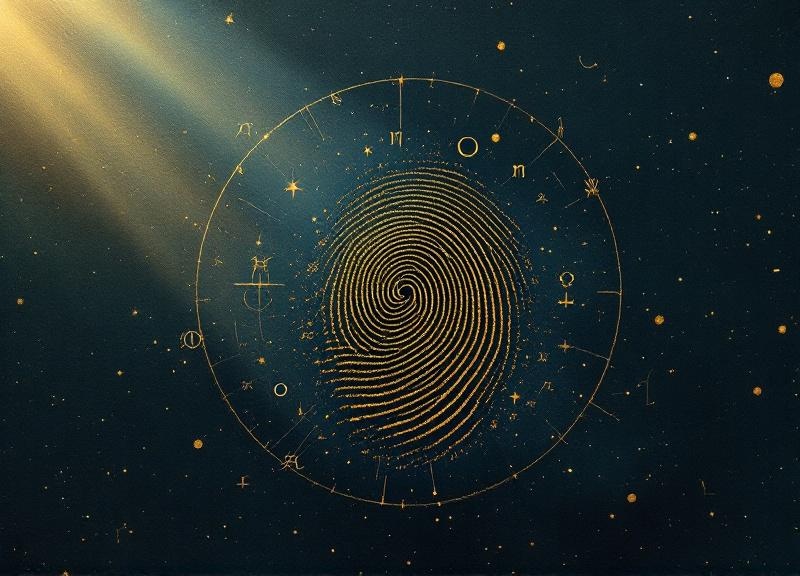
The thumb impression protocol is not arbitrary superstition — it connects directly to the Vedic understanding of hasta rekha, the lines of the hand as karmic inscription. In Vedic palmistry, the thumb holds special primacy because it represents the individual soul's will — iccha shakti.
When a Nadi reader uses your thumb print to locate your leaf, they are effectively cross-referencing two recording systems: the external manuscript and the internal inscription your own hand carries. This means a genuine Nadi reading is actually a synthesis tradition — it triangulates between your physical mark, the ancient text, and the reader's lineage training. Remove any one element, and the triangle collapses.
This is precisely why digital replication is structurally impossible, not just logistically difficult. An algorithm can analyze a chart. It cannot triangulate between a physical body, a deteriorating manuscript, and a trained human lineage holder.
The Authenticity Question: Where Experts Disagree
This is where an honest conversation gets uncomfortable — and interesting. Really.
What everyone agrees on: The Nadi manuscripts are genuine historical artifacts. The tradition is real, rooted in Tamil Shaivism, and represents a sophisticated divinatory system with centuries of documented practice. The cultural and spiritual significance of the tradition deserves genuine respect.
Where the tension lives: From a Vedic scholarly perspective, the metaphysical claim — that rishis in deep samadhi (meditative absorption) could perceive Akashic records and transcribe individual destinies — sits firmly in the realm of living faith rather than verifiable scholarship. Even the classical text Brihat Parashara Hora Shastra does not directly validate Nadi literature, despite acknowledging advanced sages' perceptive abilities.
From a psychological perspective, whether the mechanism is literally prophetic or not, the function of the reading is genuinely significant. The Jungian view suggests that the Nadi experience activates what might be called the Witness archetype — the profound sense of being completely seen across time by an intelligence larger than any individual awareness. That felt sense of recognition can catalyze real personal transformation regardless of the reading's literal accuracy.
From a data-informed sociological lens, the picture is more sobering. Investigative journalism and academic studies have identified significant fraud patterns within the commercial Nadi ecosystem — cold reading techniques disguised as manuscript verification, texts written in modern Tamil rather than archaic script, and institutional pressure to purchase expensive remedial rituals. A 2019 Indian newspaper investigation found that multiple readers in the same region produced substantially different readings for the same individual.
None of this necessarily invalidates every practitioner. But it establishes that the commercial ecosystem around Nadi reading has been substantially compromised. You can hold deep respect for the tradition while maintaining structural skepticism toward any specific practitioner — in fact, that combination is probably the healthiest approach.
Key takeaway: The tradition is real and meaningful. The commercial landscape around it is significantly compromised. Both things are true simultaneously.
Digital Nadi Alternatives: What Are You Actually Getting?
Here, all four analytical perspectives converge with unusual clarity: digital platforms claiming to offer Nadi palm leaf readings are not offering Nadi astrology by any classical definition.
A palm leaf record is a physical manuscript requiring a physical index system — your actual thumb on actual ink, matched to actual bundles of ancient leaves by a trained human reader. There's no digital equivalent to the thumb impression process, the bundle retrieval, or the Tamil scholarly reading of centuries-old manuscript text. Calling a computer-generated report a "Nadi reading" is like calling a photograph of a river the experience of swimming.
That said, many of these digital services offer Vedic chart analysis dressed in Nadi-adjacent language — "Akashic Blueprint" readings, "past life karma reports," and similar framings. Some of this content may have genuine value as astrological interpretation based on your birth chart. The issue is not that these services are worthless — it is that they are mislabeled. When you know what you are actually receiving, you can engage with it honestly.
With Saturn moving through Pisces (2023–2026), expect increasing pressure on spiritual services to demonstrate either genuine lineage or honest reframing. The vague middle ground — digital products claiming ancient manuscript authority — will likely face growing consumer skepticism, and rightfully so.
How to Spot a Genuine Nadi Reader
Whether you are considering a trip to Tamil Nadu or evaluating someone who claims Nadi credentials remotely, here are concrete markers of authenticity:
- They require your thumb impression first — not your birth details. If a reader asks for your date, time, and place of birth before beginning, they are conducting a chart reading, not a Nadi reading.
- They ask yes/no questions from the leaves — verifiable facts like a parent's name or a sibling's detail should emerge from the manuscript, not from you.
- They have documented lineage — a family or institutional connection to a recognized center (Vaitheeswaran Koil, Sirkazhi, or established temple associations).
- They can name the sage tradition they work within — Agastya, Kaushika, Bhrigu, or another specific lineage.
- They do not pressure you into escalating fees for "karma removal" rituals. The pressure-based upsell is a reliable marker of exploitation, not tradition.
- The process is slow and uncertain. Genuine leaf matching can take hours or multiple sessions. Immediate certainty? A red flag.
For any remedial measures a reading suggests — temple visits, charitable acts, homa (fire ritual) — it is wise to cross-reference them against classical Parashari remedial frameworks before committing time and money. A trusted Vedic astrologer working from your kundli can help verify whether prescribed remedies align with established tradition.
What to Do If You Can't Visit Tamil Nadu
Most people reading this will not board a flight to Chidambaram next week. That's completely fine. A few approaches can honor the spirit of the tradition without misrepresenting it:
Use Vedic chart analysis for what it genuinely offers. A thorough reading of your Rahu and Ketu placements — the lunar nodes that govern karmic patterns, past-life inheritances, and Akashic imprints — can surface much of the same material that draws people to Nadi readings. Seekers drawn to Nadi often appear during Rahu or Ketu mahadasha, when karmic debts surface naturally.
Work with a palmistry practitioner who understands the Vedic hasta rekha tradition. Your hands carry their own karmic inscription — you do not need a manuscript to begin reading it.
Practice receptivity. Spend time in morning stillness with your dominant hand open, palm facing upward. This is not performance — it's an act of alignment with how the tradition understands readiness. Arrive at any reading without a fixed agenda. The soul that comes to be known receives more than the soul that comes to be told.
Journal after any oracular experience. Write down every statement that produced an emotional charge — positive or negative. Then ask: what does my resistance to this reveal about my current self-concept? What does my attraction to it reveal about what I most need acknowledged? This transforms any reading from passive reception into active self-understanding.
Frequently Asked Questions
Can I get a real Nadi palm leaf reading online?
Not in the classical sense. Genuine Nadi astrology requires your physical thumb impression matched to physical palm leaf manuscripts by a trained reader. Some centers offer processes where you send your thumb impression through documented channels, but fully digital "Nadi readings" generated by software are a different category of service entirely. They may offer useful Vedic chart interpretation, but they are not Nadi readings.
How much does an authentic palm leaf reading cost?
Costs vary significantly. At established centers in Tamil Nadu, initial readings may be relatively modest, but the full process — including translation, multiple sessions, and any prescribed remedies — can involve considerable financial investment. Be wary of operations where costs escalate dramatically after the initial session, especially if tied to "karma removal" payments. Legitimate practitioners are generally transparent about fees upfront.
Is Nadi astrology the same as Vedic astrology?
No. Nadi astrology exists within the broader Vedic tradition but operates from a fundamentally different premise. Standard Vedic (Parashari) astrology calculates predictions from planetary positions in your birth chart. Nadi astrology claims to retrieve pre-written records transcribed by ancient sages. The Bhrigu Samhita is somewhat of a bridge — it uses chart progressions that connect more directly to mainstream Jyotish methodology.
Why do people seek Nadi readings during Rahu or Ketu periods?
The lunar nodes (Rahu and Ketu) govern karmic patterns, past-life material, and the unseen forces shaping your current incarnation. During their mahadasha (major planetary period), karmic debts and unresolved patterns tend to surface with unusual intensity. This creates a natural hunger for exactly the kind of deep karmic accounting that Nadi readings promise. You can explore your own nodal placements through a detailed birth chart analysis.
What is the difference between Agastya Nadi and Bhrigu Samhita?
The Agastya Nadi manuscripts are primarily housed in Tamil Nadu and use the thumb impression system to locate specific palm leaves. The Bhrigu Samhita, associated with Sage Bhrigu and linked to Venus (Shukra), is concentrated in Hoshiarpur, Punjab, and operates through a methodology of chart progressions rather than palm leaf matching. Both claim ancient sage authorship, but their processes and geographic traditions are distinct.
Frequently Asked Questions
What makes Nadi astrology different from regular horoscope readings?
Nadi astrology does not generate a chart from your birth data -- it claims the record of your life was already inscribed on palm leaves centuries ago by ancient sages. Most astrological traditions work forward from your details, while Nadi works in reverse, asking you to be identified by a manuscript that, according to the tradition, was waiting for you long before you arrived.
Why is a thumb impression used in Nadi astrology?
The thumb impression tends to serve as the primary sorting key for locating your specific bundle of palm leaves. Readers traditionally group manuscripts by thumb-print ridge patterns, narrowing thousands of leaves down to a manageable set. Whether this functions as a genuine metaphysical connection or simply as an indexing method is something scholars and practitioners continue to disagree about.
Are digital or online Nadi readings considered legitimate?
Digital alternatives often vary widely in quality and transparency. Some services scan and translate genuine manuscripts remotely, while others appear to generate generic readings dressed in Nadi language. Authentic palm leaf consultation traditionally requires physical presence at a recognized center, typically in Tamil Nadu, so remote versions tend to carry more uncertainty and deserve careful scrutiny before you invest trust or money.
How can I tell whether a Nadi reader is genuine?
A genuine reader typically works from a recognized temple library or established center, usually in or near Vaitheeswaran Koil or Sirkazhi in Tamil Nadu. They will ask verification questions drawn from the leaves rather than prompting you to supply personal details first. Readers who request extensive information upfront, or who guarantee specific predictions, are worth approaching with considerable caution.
What should I do if I cannot travel to Tamil Nadu for a palm leaf reading?
If travel is not possible, the more careful path is to research remote services that can document a physical manuscript and provide verifiable translation rather than simply offering a written report. Treat any remote reading as one perspective among many, cross-referencing it with a conventional astrological consultation. Managing expectations honestly tends to make the experience more useful, whatever form it takes.
Ready to explore your cosmic blueprint?
Discover what the stars reveal about your unique path.
Get Your Vedic Birth Chart

