Vimshottari Dasha Calculator Guide | Vedic Planetary Periods
By Ravi Khorana

What Is Vimshottari Dasha — And Why Does It Matter?
Here is a question that sun-sign horoscopes will never answer for you: when will a particular chapter of your life begin, and when will it end?
Western astrology tends to focus on transits — the real-time weather of the planets overhead. That is valuable. But the Vedic tradition, through the genius of Maharishi Parashara and the Brihat Parashara Hora Shastra, offers something structurally different: the Vimshottari Dasha system, a 120-year master cycle that divides your entire life into sequential planetary periods, each one governed by a specific graha (planet) acting as the presiding intelligence of that era.
The word Vimshottari simply means "120" in Sanskrit. That number represents the theoretical full human lifespan according to ancient Vedic physicians — and the total time required for all nine planetary lords to complete their governance. You will not live through all nine periods. But you will move through five to seven of them, and each one will feel qualitatively distinct from the last, like stepping from one room of a house into another.
This is not an abstract philosophical claim. Google search volume for "Vimshottari Dasha calculator" exceeds 3,000 monthly queries in the United States alone, reflecting a genuine cultural shift. People accustomed to personality-based astrology are increasingly hungry for timing — they want to know not just who they are, but when the winds change. Cyclical time, which underlies all Vedic cosmology, is resonating with a generation that has learned the hard way that linear models of progress don't always hold up.
Key takeaway: Vimshottari Dasha is not a personality tool — it is a timing tool. It tells you which planetary energy is running the show during any given period of your life.
How the Calculation Works: Moon, Nakshatra, and the 120-Year Cycle
The entire system is anchored to one data point: the Nakshatra (lunar mansion) your Moon occupied at the exact moment of your birth. This is your Janma Nakshatra, and it is the single most important factor in Dasha calculation.
Why the Moon? Both Vedic and Western depth traditions recognize the Moon as the seat of the unconscious mind — your accumulated emotional impressions, your instinctual responses, the subjective filter through which all experience passes. Beginning the Dasha cycle from the Moon's position acknowledges something psychologically sophisticated: your experience of karma is inseparable from the quality of your inner life.
Here is the mechanical process:
- Locate your Moon's Nakshatra in your birth chart. There are 27 Nakshatras, each spanning 13 degrees and 20 minutes of the zodiac.
- Identify its ruling planet. Each Nakshatra belongs to one of the nine Dasha lords (see table below).
- Determine your starting Dasha. The ruling planet of your birth Nakshatra is your first Mahadasha lord.
- Calculate the remaining balance. How far the Moon had traveled through that Nakshatra determines how many years of that first Dasha remained at birth. If your Moon sat at the midpoint of Ashwini, you entered life with roughly 3.5 years of Ketu Dasha remaining.
- Follow the fixed sequence forward — Ketu, Venus, Sun, Moon, Mars, Rahu, Jupiter, Saturn, Mercury — for the rest of your life.
A good Vimshottari Dasha calculator handles all of this instantly once you input accurate birth data, including birth time and location.
The Nine Planetary Periods at a Glance
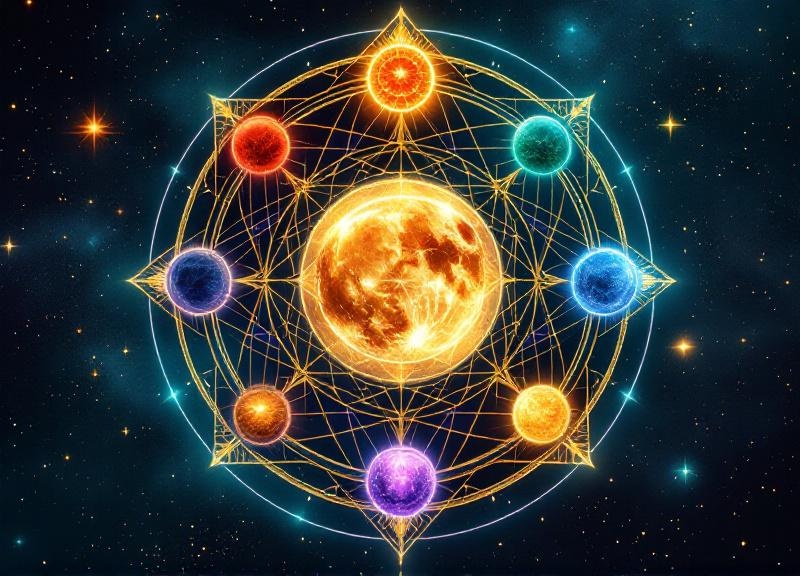
| Planet (Graha) | Mahadasha Duration | Nakshatras Ruled | Core Themes |
|---|---|---|---|
| Ketu | 7 years | Ashwini, Magha, Mula | Spiritual seeking, release, past-life activation |
| Venus | 20 years | Bharani, Purva Phalguni, Purva Ashadha | Relationships, creativity, material comfort |
| Sun | 6 years | Krittika, Uttara Phalguni, Uttara Ashadha | Authority, identity, vitality |
| Moon | 10 years | Rohini, Hasta, Shravana | Emotional growth, nurturing, public connection |
| Mars | 7 years | Mrigashira, Chitra, Dhanishta | Drive, conflict, physical energy, courage |
| Rahu | 18 years | Ardra, Swati, Shatabhisha | Worldly ambition, obsession, foreign connections |
| Jupiter | 16 years | Punarvasu, Vishakha, Purva Bhadrapada | Expansion, wisdom, faith, teaching |
| Saturn | 19 years | Pushya, Anuradha, Uttara Bhadrapada | Discipline, limitation, hard-won mastery |
| Mercury | 17 years | Ashlesha, Jyeshtha, Revati | Communication, commerce, intellect, adaptability |
A critical point all four of our research perspectives agree on: no Mahadasha is inherently good or bad. A Saturn period can deliver extraordinary professional results if Saturn is a yogakaraka (ruling both a trine and an angle in your chart). A Jupiter period can bring poor judgment and collapse if Jupiter rules difficult houses or is afflicted. The duration is fixed. The expression is entirely personal to your chart.
How to Interpret Your Current Mahadasha
Knowing your Mahadasha planet is step one. Interpreting what it will actually do in your life requires looking at three factors in your birth chart:
- Which houses does the Dasha lord rule? A planet ruling the 10th house will bring career themes front and center. One ruling the 7th activates partnership. The 8th? Expect transformation, hidden matters, and sometimes crisis that leads to renewal.
- Which house does the Dasha lord occupy? Where it sits shows the life arena most directly activated during its period.
- What is its dignity? Is it exalted, debilitated, in its own sign, or combust? A Venus Mahadasha with Venus exalted in Pisces ruling the 5th house is a fundamentally different experience than Venus debilitated in Virgo conjunct Rahu.
Within each Mahadasha, nine sequential Antardashas (sub-periods) cycle through, creating what practitioners call a double lens — the outer climate and the inner season operating simultaneously. A Jupiter Mahadasha with a Saturn Antardasha asks entirely different questions than Jupiter-Venus. The stage stays the same; the scene changes.
Key takeaway: Always read Mahadasha and Antardasha together. The major period sets the chapter; the sub-period writes today's page.
The Nakshatra Layer Most People Miss
Here is an insight that most Dasha calculators leave out and most introductory guides skip entirely: the Nakshatra of the Mahadasha lord itself shapes the emotional texture of the entire period.
Most tools tell you your current Mahadasha planet. Fewer tell you which Nakshatra that planet occupied in your birth chart — and that Nakshatra becomes the subtext running beneath everything. A Rahu Mahadasha where natal Rahu sits in Ardra (Rahu's own Nakshatra, associated with storms and radical transformation) reads entirely differently from Rahu in Rohini (the Moon's Nakshatra of beauty, sensuality, and material attachment).
The planet sets the chapter's theme. The Nakshatra sets its feeling tone.
This matters because Parashara built the entire Vimshottari architecture on the Nakshatra spine. The system is, at its deepest level, a Nakshatra period system wearing planetary clothing. If you skip this layer, you are reading chapter titles without opening the book.
Western Psychology Meets Vedic Timing
Here is where honest disagreement among traditions becomes genuinely interesting.
From a Jungian perspective, each Mahadasha functions as a stage of individuation — the Jungian term for the soul's developmental unfolding. A Saturn Mahadasha of 19 years mirrors what Jung called a confrontation with the senex archetype: limitation, authority, mortality, and the terrifying necessity of form. A Rahu period maps onto the archetype of insatiable desire — the shadow material that demands to be made conscious.
From a classical Vedic perspective, this psychological reading, while intellectually elegant, misses something essential. The Vedic tradition does not treat Dasha primarily as psychological development. It treats it as karma unfolding on schedule — the activation of latent karmic patterns stored in the birth chart. The distinction matters: one framework says "this period invites growth," while the other says "this period delivers what is owed."
Both perspectives agree on one thing: Mahadasha transitions are among the most consequential turning points in a human life. The final 6-12 months of an outgoing Dasha and the first 12-24 months of the incoming one form a threshold period where career shifts, relationship changes, relocations, and spiritual awakenings cluster with remarkable consistency. The Jungian tradition would call this a liminal passage. The Vedic tradition would call it a handoff between planetary lords. Either way, pay attention.
An intriguing cross-tradition observation: Western astrology's famous Saturn return at age 29.5 frequently lands inside or near a Vimshottari Dasha transition. When a Saturn return and a Saturn Mahadasha overlap, the intensification is not coincidental — it is the same river meeting itself. You can explore your full chart context, including Saturn's placement, through your natal chart.
Practical Remedies and Rituals for Dasha Transitions
The Vedic tradition offers specific upayas (remedies) for each planetary period. Here are actionable approaches:
For Mahadasha transitions specifically: In the week before a new Mahadasha begins, perform a simple sankalpa (intention ritual) on the day ruled by the incoming planet — Sunday for Sun, Monday for Moon, Tuesday for Mars, Wednesday for Mercury or Rahu, Thursday for Jupiter, Friday for Venus, Saturday for Saturn or Ketu. Light a ghee lamp, state aloud what you are releasing from the previous period and what quality you are inviting into the new one. This is not superstition — it is conscious threshold-marking, and it gives your psyche a clear signal that the chapter has turned.
Period-specific practices:
- Ketu Mahadasha: Emphasize spiritual practice, ancestor remembrance, and letting go of attachments. The Ketu Beeja Mantra on Tuesdays strengthens inner steadiness.
- Rahu Mahadasha: Channel ambition through service. Charitable giving to marginalized communities aligns with Rahu's energy. The Durga Saptashati recited on Saturdays is a classical recommendation.
- Saturn Mahadasha: Humility, service to the elderly, disciplined routine. Saturn punishes shortcuts and rewards patience. The Hanuman Chalisa is a time-honored daily practice during Saturn periods.
- Jupiter Mahadasha: Teaching, studying, donating to educational causes, ethical self-review. Consider yellow sapphire only when Jupiter is a functional benefic with strong dignity — consult a practitioner first.
A Jungian-flavored alternative: Keep a reflective journal for 30 days tracking where your current Mahadasha planet's themes appear in dreams, relationships, and recurring frustrations. This is particularly powerful during Rahu periods, where unconscious hunger patterns become visible if you watch for them.
For marriage timing and compatibility, understanding both partners' Mahadasha cycles adds a dimension that standard synastry analysis alone can miss. Two people simultaneously in Saturn periods may consolidate a relationship into remarkable strength — or discover it cannot bear the weight.
Frequently Asked Questions
How do I find my current Vimshottari Dasha?
You need your exact birth date, time, and location. A Vimshottari Dasha calculator — available through our astrology calculators page — will identify your Moon's Nakshatra, determine your starting Dasha, and map every Mahadasha and Antardasha across your entire lifetime. Accurate birth time is essential; even a few minutes' difference can shift your Nakshatra balance and alter the timing of Dasha transitions.
Is the Vimshottari Dasha system scientifically proven?
Honest answer: not by the standards of controlled empirical studies. The most cited research (Shawn Carlson's 1985 Nature study) tested Western natal astrology, not Vedic predictive methodology. Within the Vedic tradition, the evidence is largely practitioner-based case studies and retrospective correlation — meaningful but vulnerable to confirmation bias. What is demonstrable is the system's mathematical internal coherence and its unbroken use across fourteen centuries by millions of practitioners. Whether you weight that as evidence depends on your epistemological starting point.
Can I be in two Mahadashas at once?
Not technically — you are always under one Mahadasha lord at a time. However, during transition windows (roughly the final year of an outgoing Dasha and the first year of the incoming one), both planetary influences are palpable. Classical texts like the Phaladeepika explicitly flag these transitions as the most significant turning points in a lifetime.
What is the difference between Mahadasha and Antardasha?
Mahadasha is the major period — the overarching chapter, lasting years or even decades. Antardasha is the sub-period within it, lasting months to a few years. Think of Mahadasha as the season and Antardasha as the current weather within that season. Classical Jyotish also recognizes even finer divisions (Pratyantardasha, Sookshma, Prana), but working with Mahadasha and Antardasha together provides sufficient precision for most life analysis.
Does Vimshottari Dasha work with Western astrology?
This is genuinely debated. The two systems use different zodiacs (sidereal vs. tropical), which means planetary positions differ by roughly 24 degrees. Vimshottari Dasha is specifically designed around the sidereal Nakshatra framework and does not translate directly into tropical chart interpretation. That said, many modern practitioners use both systems side by side — reading Vedic Dashas for timing and Western transits for present-tense psychological dynamics. The Jungian perspective finds rich archetypal parallels, even while acknowledging the two traditions operate from different foundations.
Frequently Asked Questions
What is Vimshottari Dasha and how is it different from Western transits?
Vimshottari Dasha is a 120-year Vedic timing system that divides life into sequential planetary periods, each ruled by one of nine grahas. Unlike Western transits, which track real-time planetary weather, this system assigns a presiding planetary intelligence to entire chapters of your life, offering a longer-range view of when certain themes tend to ripen or recede.
How is my Vimshottari Dasha calculated?
The calculation starts with your natal Moon's nakshatra, the lunar mansion it occupied at birth. That nakshatra determines which planetary period you were born into and how much of it remained. From there, the nine planetary periods unfold in a fixed sequence, each running for a set number of years, totaling 120 years across the full cycle.
How long does each planetary period last in the Vimshottari system?
Each of the nine planets rules a period of different length, ranging from 6 years to 20 years. The Sun's period lasts 6 years, while Venus rules the longest at 20 years. The specific durations are fixed within the tradition and do not change from chart to chart, though when you enter each period depends on your birth nakshatra.
Can I experience the effects of a Mahadasha if the ruling planet is weak in my birth chart?
A weak or challenged planet often still produces noticeable effects during its Mahadasha -- the chart suggests the themes may arrive with more friction, delay, or internal pressure rather than smooth expression. Many people report that a difficult Mahadasha ruler teaches through obstacles, while a well-placed one tends to open doors more readily during that same span of years.
Do I need my exact birth time to use a Vimshottari Dasha calculator?
A reasonably accurate birth time is important because the Moon moves through a nakshatra in roughly 24 hours, and even a few hours' difference can shift which period you are in and how many years remain in it. Approximate times can still give useful results, but the closer to the exact minute, the more reliably the period start dates tend to align with real events.
Ready to explore your cosmic blueprint?
Discover what the stars reveal about your unique path.
Get Your Vedic Birth Chart

